smiling-grouch:

eroticincubi:

youcantseebutimmakingaface:

remielangel:

taigas-den:

imthehandsomejack:

sebatticus:

prankstersgambits:

billybrocobra:

For all the artists out there

Youre telling me I threw away 10 dollar markers FOR NOTHING

REBLOG to save a life and a wallet!

Plus copics are actually refillable and you can buy more colored ink online for pretty cheap!

So yeah dont throw out copics.

Omg that hurts me that people threw away such expensive markers. Omg. I have like $400 worth of those things

The fact that they’re refillable is something I really want to stress, here!

Copics are very pricey upfront, but a refill costs around the same price as the marker. That single refill can fill your marker up like, 10 times. 

So lets say you pay $5 per marker. If you toss them and replace them, there goes $55 per color.

If you were to just refill them, you’re out of pocket like, $10 by comparison. 

The nibs are also replaceable!

Reblog to save an artist

@silver-kitsuneneko

My favorite place to get ink refills is Imagination International. They have every color of Copic available and each size including a bunch of accessories. A bottle of ink has about five refills (at least) goes for $9.

So you could spend $35 on five different markers or $14 for one and bottle of ink.

BONUS: They also sell IC screentone! Their variety is huge, the sheets are large (10×14 at least), and the prices are fair! I’ve really been enjoying IC’s stuff.

HERE’S A LINK TO THEIR WEBSITE
QUICK LINK TO THEIR COPIC STORE
QUICK LINK TO THEIR IC STORE (home of many traditional manga supplies)

Shipping is fair and fast, and their website also serves as a remarkable resource for artists who need tips or just want to print out some coloring pages.

Side note: They’re based in Eugene, OR, too, which is home to my alma mater and makes me love them even more! (Go Ducks!)

jadelyn:

chronic-illness-cat:

titleknown:

hueva-york:

la-bufadora:

businessinsider:

Infographic: 7 Reasons This Is An Excellent Resume For Someone With No Experience

yoooo what i need by tomorrow

AAAAAHHHHH!!!!!!!!!

THANK YOU THANK YOU THANK YOU

Reblogging because I WISH I HAD FUCKING KNOWN ABOUT THIS IN HIGH SCHOOL YEARS AGO!

Dear sick Kitties, 

Please save this to your computer because one day you might be well enough to work in some capacity and it’s unfair for you to have blank spots on your resume/CV. 

You have worth and validity even if you don’t have a huge work history. YOU have value.

This is mostly really good, but I have a couple minor disagreements.  So…here are three recommendations from an HR person who reads a shitton of resumes every day:

  1. Move the skills section up to the top!  You know what I give a fuck about the most when I’m reading a resume (at least for entry-level positions)?  WHAT YOU CAN DO.  I frankly don’t give a shit where you learned it.  Tell me what you’re capable of in concrete terms, organized in a bullet-points list or table that I can quickly scan to see if you even stand a chance of matching what we need, because that is all I’m doing in those critical first couple of seconds that decides whether I even bother looking at the rest of the resume.  (Which I get sounds kinda callous but when I have to get through a couple dozen resumes, meaning download, open, read, decide what to do, forward it to the appropriate person if it makes the cut with my comments/summary/recommendations, file it appropriately and go on to the next one, and get back to my other duties and responsibilities – which I don’t have enough hours in the day for as it is – I can’t afford to depth-read every single resume that hits my inbox.)
  2. Include volunteer experience as work experience if you have any.  Running the concession stand at a high school club event of some kind counts as cash handling and customer service experience.  Making blog themes for your friends counts as web design experience.  Just because you weren’t getting paid doesn’t mean it wasn’t work experience you can potentially leverage to get actual paying work.
  3. Rework that top statement – in its current form it’s looking like some odd hybrid of an executive summary (good!) and an objective statement (bad!), and I’m not sure how I feel about it tbh.  I think it’s the “leveraging…to positively contribute” bit that is pushing all my “ugh no fucking shit sherlock” buttons.  Like…what were you going to say, that you want to skate along doing the bare minimum amount of work and you don’t give a shit about the organization’s goals?  I see way too many regurgitated statements like that – “positively contribute” and “maximize success” and “utilize my skills to further goals” etc. – and they just make my eyes roll out of my head at this point because they’re so generically corporate.  I’d rather see a declarative statement about what you are and what you can do, than what you want.

However, huge massive bonus points for putting language fluency right there at the top where I don’t have to go hunting for it – language skills are ALWAYS ALWAYS ALWAYS A PLUS and you want to highlight that shit as hard as you can.  Shove that language fluency in my fucking face, PLEASE.  Better that than having to scour your work history for mention of translation or anything like that, which I will only do if I’m A: already liking your qualifications so far, and B: totally fucking desperate for someone who speaks goddamn Spanish already.

liongirlart:

Hair Tip #1 – When drawing hair, start with the hairline and hair part(s). Then keep the flow and volume in mind while you add details!

I’m not the best at drawing or painting hair, but someone on instagram requested that I make a post about it so hopefully this will help someone! This is the first of 3 tips I’m going to share.

grizandnorm:

Tuesday Tips – Cape It Simple!

I don’t need to add too much explanation today. A cape, cloak or long coat simplifies the silhouette of most character, gives them a unique look or presence and conceals a lot of the overall anatomy. Keep track of the character underneath to know where to fold, drop or stretch the fabric. The fabric itself should play a role too. Different behave differently. Movement and gravity are key to “ground” your character in the environment and make it look believable.
-Norm @grizandnorm #capeitsimple #100tuesdaytipsbook #100tuesdaytips #arttutorial #arttips

Eyes, Skin, Face, Hair, Build: Character physical descriptions.

daddigabi:

Eyes – General

large, small, narrow

sharp, squinty, round

wide-set, close-set, deep-set

sunken, bulging, protruding

wide, hooded, heavy-lidded

bright, sparkling, glittering

flecked, dull, bleary

rheumy, cloudy, red-rimmed

beady, birdlike cat-like

jewel-like, steely, hard

fringed with long lashes, with sweeping eyelashes, with thick eyelashes

Eyes – Color

chestnut, chocolate brown, cocoa brown

coffee brown, mocha, mahogany

sepia, sienna brown, mink brown

copper, amber, cognac

whiskey, brandy, honey

tawny, topaz, hazel, obsidian

onyx, coal, raven, midnight, sky blue, sunny blue

cornflower blue, steel blue, ice blue

Arctic blue, glacial blue, crystal blue

cerulean, electric blue, azure

lake blue, aquamarine, turquoise

denim blue, slate blue / slate gray, storm blue / storm gray

silver / silver gray, chrome, platinum, pewter

smoky gray, ash gray, concrete gray, dove gray

shark gray, fog gray, gunmetal gray, olive

emerald, leaf green, moss green

Eyebrows

arched, straight, plucked, sparse

trim, dark, faint, thin, thick, unruly

bushy, heavy

Skin – Color

amber, bronze, cinnamon

copper, dark brown, deep brown

ebony, honey, golden

pale, pallid, pasty

fair, light, cream / creamy

alabaster, ivory, bisque

milk, porcelain, chalky

sallow, olive, peach

rose / rosy, ruddy, florid

russet, tawny, fawn

Skin – General

lined, wrinkled, seamed

leathery, sagging, drooping

loose, clear, smooth

silken, satiny, dry

flaky, scaly, delicate

thin, translucent, luminescent

baby-soft, flawless, poreless

with large pores, glowing, dewy

dull, velvety, fuzzy

rough, uneven, mottled

dimpled, doughy, firm

freckled, pimply, pockmarked

blemished, pitted, scarred

bruised, veined, scratched

sunburned, weather-beaten, raw

tattooed

Face – Structure

square, round, oblong

oval, elongated, narrow

heart-shaped, catlike, wolfish

high forehead, broad forehea, prominent brow ridge

protruding brow bone, sharp cheekbones, high cheekbones

angular cheekbones, hollow cheeks, square jaw

chiseled, sculpted, craggy

soft, jowly, jutting chin

pointed chin, weak chin, receding chin

double chin, cleft chin, dimple in chin

visible Adam’s apple

Nose

snub, dainty, button

turned-up, long, broad

thin, straight, pointed

crooked, aquiline, Roman

bulbous, flared, hawk, strong

Mouth/Lips

thin, narrow, full

lush, Cupid’s bow, rosebud

dry, cracked, chapped

moist, glossy, straight teeth

gap between teeth, gleaming white teeth, overbite

underbite

Facial Hair 

clean-shaven

smooth-shaven

beard

neckbeard

goatee

moustache

sideburns

mutton-chop sideburns

stubble

a few days’ growth of beard

five o’ clock shadow

Hair – General

I threw a few hairstyles in here, though not many.

long, short, shoulder-length

loose, limp, dull

shiny, glossy, sleek

smooth, luminous, lustrous, spiky

stringy, shaggy, tangled

messy, tousled, windblown

unkempt, bedhead, straggly

neatly combed, parted, slicked down / slicked back

cropped, clipped, buzzed / buzz cut

crewcut, bob, mullet

curly, bushy, frizzy

wavy, straight, lanky

dry, oily, greasy

layers, corkscrews, spirals

ringlets, braids, widow’s peak

bald, shaved, comb-over, afro

thick, luxuriant, voluminous

full, wild, untamed

bouncy, wispy, fine, thinning

Hair – Color

black, blue-black, jet black

raven, ebony, inky black

midnight, sable, salt and pepper

silver / silver gray, charcoal gray, steel gray

white, snow-white, brown

brunette, chocolate brown, coffee brown

ash brown, brown sugar, nut brown

caramel, tawny brown, toffee brown

red, ginger, auburn, Titian-haired

copper, strawberry blonde, butterscotch

honey, wheat, blonde

golden, sandy blond, flaxen

fair-haired, bleached, platinum

Body Type – General

tall, average height, short

petite, tiny, compact

big, large, burly

beefy, bulky, brawny

barrel-chested, heavy / heavy-set, fat

overweight, obese, flabby

chunky, chubby, pudgy

pot-bellied, portly thick

stout, lush, plush

full-figured, ample, rounded

generous, voluptuous, curvy

hourglass, plump, leggy / long-legged

gangling, lanky, coltish

lissome, willowy, lithe

lean, slim, slender

trim, thin, skinny

emaciated, gaunt, bony

spare, solid, stocky

wiry, rangy, sinewy

stringy, ropy

Character Development: Speech

riona-is-writing:

Finding your character’s voice is one of the most important things you can do to make your character more fully developed. It can often be the thing that sets your character apart and makes the reader easily able to identify them. Creating your character’s voice breathes life into them.

What to think about:

Formal or informal

image

Can be shown with:

  • sentence structure/complexity (shorter vs. longer sentences, number of clauses, etc.) 
  • contractions (e.g. y’all versus you guys, I am vs. I’m)
  • word choice (simple or advanced; more poetic vs. more practical, blunt vs. subtle)
  • word order/syntax (can indicate dialect and/or formality)

Things to ask yourself:

– If my character speaks formally/informally, is there a reason?

– Does it indicate their status?

– Or is it a rejection of their status? (e.g. does your highborn character prefer to speak informally because they hate their position in life, or does your lower class character speak more formally to make themselves appear higher class?)

– Is the way they speak normal for their society? In other words, if your character is, say, an alien from a highly formal culture, they won’t think of themselves as speaking abnormally. But if they visit another, less cultured planet, they’ll stick out like a sore thumb.

Catchphrases

image

When done well, this can be amazing. When done awfully, it makes the reader sigh and roll their eyes in exasperation. So, be careful not to overdo it!

Catchphrases can include:

  • slang (e.g. wicked, if your character is from Boston, like Faith Lehane from Buffy: the Vampire Slayer)
  • exclamations/swears (”Hell’s bells!” – Harry Dresden, “Zoinks!” – Shaggy, “Holy ___, Batman!” – Robin at various times)
  • automatic responses (such as in response to how they are, e.g. “Five by five.” – Faith Lehane, or in response to a question they don’t want to answer, e.g. “Spoilers!” – River Song)
  • greetings/goodbyes (”Hello, sweetie.” – River Song, “What’s up, Doc?” – Bugs Bunny)
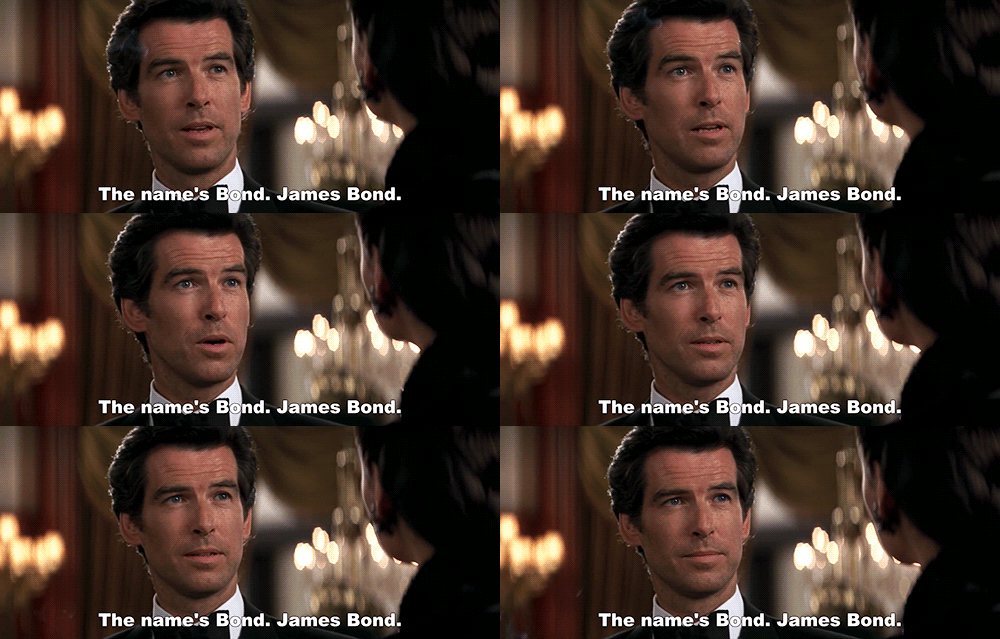
  • introducing themselves ( “The name’s Bond. James Bond.” – James Bond, “Trust me. I’m the Doctor.” – the Doctor, “Denny Crane,” said repeatedly by Denny Crane)
  • an explanation/repeat phrase of some other classification (”Dammit, Jim, I’m a doctor, not a ________.” – Bones, “Your mission, should you choose to accept it…” – Mission Impossible, “Live long and prosper.” – Spock, “Same thing we do every night, Pinky! Try to take over the world!” – the Brain)

A lot of times, these catchphrases can become inside jokes, and merely referencing them is enough (think: “It’s a bird! It’s a plane! It’s Superman!” or “Holy _______, Batman!”).

But sometimes, it can feel a little forced (like Miss Martian’s constant use of “Hello, Megan!” all the time in Young Justice). You want to use these catchphrases sparingly, and when they make sense. While you and I might say “fudge” or another such exclamation any time we trip, the reader does not want to read that twenty times in the same chapter because your character is a klutz. This is the art of writing, not the hyperrealism of writing. You want it to mean something, so use it only when needed.

Things to ask yourself:

– Does this character really need a catchphrase? How will this help establish character?

– Does the catchphrase come from the type of place they live or things they do? For instance, Harry Dresden is a wizard, so when he swears he says, “Hell’s bells,” which reminds us of his job and difference from those around him. This wouldn’t be the same if he simply said, “Dang it,” any time he swore.

– Is there a reason they have a catchphrase? Is it deliberate or unconscious on their part?

– Is there a way you can flip the catchphrase and use it to signal a shift in the story or an unexpected twist (e.g. signifying that somehow your character as switched bodies with another person, like Faith from Buffy: the Vampire Slayer; alternatively, that something isn’t right with the character, because of certain events, and they’re not saying their usual catchphrase)?

Verbal Tics*

image

Verbal tics are sounds that are not really words, more like filler, that get used almost unconsciously in everyday speech. Words like “ehm,” “uh,” and so on are all verbal tics. (Various internet sites assure me that throat clearing and sniffing can also be included here, but I leave that up to you.) For this section, however, I am also including words, but only those words that are filler. I am also including alterations to the text that represent how someone is speaking.

Now, I know that in any writing guide you read, they want you to NOT, NOT, NOT use regular tics like these in dialogue. It’s annoying, repetitive, annoying, serves no purpose, annoying, and so on. In a sense, they are very much right. Don’t use verbal tics for every character! But using them to distinguish one character (or a couple, in different ways) can work very well if done right.

Verbal tics can be:

  • words (examples: “You don’t wanna mess with us, see, ‘cause we’re dangerous, see,” or “So, I went to the mall yesterday, and there was this dress, so I bought it, so…” or even “Like, I’m not even sure what Vanessa was, like, wearing at that party last night?”)
  • filler sounds (e.g. “eh,” “um,” “uh,” “er,” “hrrgh,” “urk,” and so on)
  • messing with the letters and format of the sentence (e.g. dragging out the letter, making every word separated for a slow speaker, running words together to indicate speed, etc.)

Examples of verbal tics (this is a section in which examples are very helpful, so here you go):

  • Damian Wayne, the current Robin at DC Comics: uses the distinctive sound “tt” in his appearances to express his emotions, even – tt – other comic series that he guest-stars in
  • Asmodeus from the Redwall series: drawsss out the letter ssss becaussse he isss a ssssnake
  • The Flash, at various points in DC Comics: speakswithallthewordstogetherbecausehe’stalkingsofast!!!
  • Canada, from the Hetalia anime: ending every sentence like a true Canadian, eh?

Things to ask yourself:

– What purpose would a verbal tic have for my character? Do they really need one?

– Is the verbal tic connected to an emotion, or is it involuntary? (Generally, in real life, it is involuntary, but once again, this is art, and so it can have meaning, if you so choose!) What emotion might it be connected to?

– Are they aware of it? Are they embarrassed by it? Do people make fun of them for it?

– Is it part of their dialect/culture?

– Is it a recent thing or have they always done it?

– Where is the balance between making it seem like a realistic tic and annoying my reader with the repetitiveness?

*I am not referring to any medical diagnoses here, although if you want to go right ahead and use medically diagnosed tics for a character, please feel free to! However, this section does not deal with those, as I am not an expert, although I understand there might be some confusion due to the terminology I have used. Please let me know if there is a different term I should be using instead, as I couldn’t find one anywhere. Thanks!

Ways of addressing others

image

The way that your character addresses other characters says a lot about how they view and respect those around them, in addition to their personality. In addition, if you establish a character addresses others in a certain way (say, by last name only), then when they break this pattern, the reader knows it is important.

Different ways of addressing others:

  • nicknames (either a shortening of someone’s name, even if it’s not usually shortened, or a name reflecting some characteristic of theirs – e.g. “Jane” to “Janie,” or “Shorty,” or Tony Stark’s brand of nicknames, like “Capsicle” or “Rock of Ages”)
  • titles (similar to nicknames, but more formal – e.g. a character referring to people by their rank, job, familial relations, etc.)
  • last name only 
  • full name only (never shortened, includes first, last, and middle names)
  • no nicknames (never refers to a character by anything other than what’s printed on their birth certificate, can be combined with others on these lists, especially the previous two)
  • familial referencing (e.g. Aragorn, son of Arathorn)
  • insults (ranging from harmless to aggressive, can be combined with the first one on this list, not always swears)
  • by physical/personal characteristics [epithets]** (e.g. by gender, hair color, eye color, traits – for instance, “boy,” “you, redhead!” or “the only one of you with any spine”)

** This one tends to work best in stories set in older times or in sci-fi/fantasy. Epithets can be insults, but the epithets I am thinking of are more Homeric in nature.

Things to ask yourself:

– Is there a reason behind my character’s decision to address people in this way? Does it indicate a lack of trust? A need to crack jokes?

– What does this say about my character’s background? Is this the normal way to address people where they come from? Is it abnormal to do so in the place they are now?

– Does my character evolve from speaking this way? Do they start speaking in a different way, either deliberately or unconsciously? Why?

Accents

image

Accents are tricky. There are several different ways to write accents (I’m currently working on a post that explains them further), but basically no matter how you write an accent, there are a few things you can do to portray the accent.

  • slang (e.g. barbie = barbecue in Australian slang)
  • word order/syntax (e.g. “I’m after going to Mary’s” = “I just went down to Mary’s” in Hiberno-English)
  • contractions (I’ve versus I have, or y’all versus ye vs youse vs you and so on)
  • idioms (words or phrases that do not have equivalents in other dialects/languages/places)
  • diction (words meaning different things, like “chips” in American English and in British English)
  • verbs (e.g. “ain’t,” “be,” “runnin,” or mixing up tenses)

Keep in mind:

– be RESPECTFUL of whatever accent you’re trying to portray, especially if it’s not your accent

don’t overdo the accent because it might end up sounding stereotypical (and that is not respectful – see above)

you should get a feel for the accent you’re trying to write. Listen to the music, read something in that accent, watch/listen people talk in the accent until you hear the rhythm and way people with that accent talk. 

Things to ask yourself:

– Is the way I am portraying this accent as accurate as it is within my power to make it? (In other words, have I done my research?)

– How does my character feel about their accent? Are they in a place where their accent is normal? Are they in a place where they stand out because of their accent?

– Continuing on that thought, how noticeable is their accent? Is it the equivalent of someone from, say, Boston going somewhere else in Massachusetts, or the equivalent of that person from Boston going to California, or the equivalent of that same person going to London? Each one becomes more and more noticeable the farther the person goes from their home.

– Has my character made an attempt to hide their accent? Deliberately intensify it? Or do they just not care?

– Does it get stronger or weaker based on their emotional state?

Emotion

image

The emotions your character normally expresses when they’re speaking say a lot about their general emotional state. In addition, if there is a change in their emotional state, readers will be able to know that just from the way they talk (though context and body language are always useful!)

You can show emotion in speech through:

  • speed (if they’re easily excited, they might talk fast! and with a lot of exclamation points! But if they’re sad a lot…well, they might talk a bit more slowly and take their time…kind of like Eeyore.)
  • word choice (is it generally positive? negative? Or somewhere in between?)
  • reactions to other characters’ dialogue (are they generally patient and wait for the other person to finish? Or do they jump in because they’re so excited about something the other person has said?)
  • volume (are they loud? Quiet? Are they normally quiet but get loud when they’re angry? Or vice versa?)
  • understandability (not necessarily stuttering or stumbling over words, but can be; are their procession of thoughts/logic easy to understand? Is their conclusion sensible? Are they understanding others easily or do they need clarification? For instance, if your character is easily excited, maybe their dialogue comes in a jumble of words that is hard to understand. Maybe they’re so angry they’re not listening to anything the other person is saying, and their dialogue reflects that.)
  • punctuation/capitalization (are they unsure of themselves and what they’re saying a lot, so they use a lot of question marks like this? Are they aggressive in their emotions and so THEY SHOUT LIKE THIS!!! Are they…kind of thoughtful and take the time to…express themselves correctly…or are they – well – I mean are they – like – the kind of people who – you know, backtrack and correct themselves a lot?)***

***Again, you want to be careful not to overdo this, as it can get annoying AND lose the effect it has on the reader. If one of your characters SHOUTS. EVERYTHING. THEY. SAY. THEN WHEN SOMETHING REALLY IMPORTANT HAPPENS TO THE CHARACTER AND THEY GET VERY EMOTIONAL AND SHOUT, IT’S LOST A TON OF EMOTIONAL IMPACT ON THE READER. Like the end of that sentence. Did it make a big impact on you? It should – it was the entire point of the sentence. But it was lost amidst all of the other capitalized words. The same thing goes for any type of repeated punctuation/capitalization for a character – you want to make sure it counts.

Things to ask yourself:

– Why does my character express this emotion generally? 

– What does it say about their outlook on life?

– What does that say about how they view other people?

– Does their dialogue rely on these techniques too much when trying to show their emotions? How can I combine these with their body language?

Focus/Fixations

This is a pretty simple one. Focus can be organization of thoughts – basically, what idea(s) can they or want to focus on. A character that is very focused might be a practical person who is focused on the here and now, and their plans for whatever situation they’re in. A character that is less focused might be someone who thinks of several things at once, which reflects in their dialogue. 

Fixations are the things that their minds keep coming back to. So for example, if a character is worried about how they did on a test, throughout the story their dialogue might keep returning to that subject or referencing it. For instance: “Hey, when do you think we’re getting that test back?” or “Wow, this is pretty hard. Almost as hard as that test we took.” You want to make it less obvious than this, of course! (A good example is Anya from Buffy: the Vampire Slayer and her obsession with making money.)

Ways to show focus/fixation:

  • number of ideas/topics in their dialogue at a time
  • relevance of topics to the present
  • relevance of topics to the past/future
  • how they react to people who do not share their focus/fixation (e.g. a focused person finds it annoying when a person who is not focused keeps interrupting them, or a person who is less focused finds it annoying that a person who is focused is paying too much attention to one thing) 

Things to ask yourself:

– How focused are they when talking?

– Do they think of a million things at once, or just one at a time? 

– What are some short-term fixations they might have? Some long-term?

– Why might they be focused/not focused? Why might they have these fixations? What do these fixations say about their character?

– Do the focus/fixations change over time? How? Why? Does it reflect a change in their character?

– Am I making my character too focused/fixated on something? Is it detracting from or adding to the story or the character arc?

How others see them vs. how they see themselves

image

This one is probably the broadest one on the list. There aren’t specific things you can do to get this across (it’s more of a general thing), but it’s a cycle that you should keep in mind.

Your character sees themselves in a certain way. For instance, they might think of themselves as helpful, or kind. 

  • The way that they see themselves can influence why they do things (e.g. if they see themselves as a person who doesn’t go on adventures, like Bilbo Baggins, they will refuse to go on an adventure.)
  • The actions that they take influences how other characters see them, but the other characters do not necessarily see your character’s perception of themselves (e.g. in the Hobbit, Bilbo sees himself as helpful and averting war by giving the Arkenstone to the Elves. He thinks he is being a good friend. However, Thorin sees it as a betrayal and thinks Bilbo is disloyal and not a good friend. Both of them at the time of their actions think they are right.)
  • How other characters see your character influences how they treat your character (e.g. Because Thorin thinks Bilbo has betrayed him, he threatens Bilbo and rejects him as a friend. Bilbo escapes with his life, but only through the help of the other dwarves. Again, to each character, their own actions are justified and so their dialogue reflects their belief that they are right. So, when they talk to each other, both of them think that they are right and the other is wrong, and you can see this in their dialogue.)
  • How they treat your character influences how your character sees and reacts to these people, and can influence your character’s perception of themselves (e.g. Because Thorin rejected Bilbo and called him a traitor, Bilbo is bewildered and believes for a time that Thorin cannot be saved, and he feels like he failed).
  • The cycle continues.
  • All of this is reflected in their dialogue to each other.

Knowing how each of your characters see each other and themselves will influence their dialogue and reactions to each other. Characters can misunderstand each other, underestimate someone, or help someone feel better about themselves, just to name a few things. 

Things to ask yourself:

– How does my character see themselves? Why? Are they one hundred percent correct?

– How do other characters see my character? Why? Are they one hundred percent correct?

– Does my character have any idea of other people’s perceptions of them? If so, do they care? Is my character correct about what they think other people think about them?

– Will my character’s perspective of themselves/other people change? Why and how? Will other characters’ perspectives of my characters change? Why and how?

– How do all these reactions to each other influence the story?


Hope this helped! Let me know if there are any questions.

– Riona

talesfromweirdland:

Some sample pages from Andrew Loomis’s series on how to draw comics, 1939-1961, concerning perspective and composition. (The changes in font and layout stem from the fact the pages come from different prints.)

I tried to collect the most useful pages, but of course I’m limited to only 10 images per post.

This is a follow-up of sorts of the Disney “how to draw comics” handouts I posted earlier, and which can be found HERE.