I jotted down for a friend of mine some tips and notes on how I approach drawing hair, and things I keep in mind while doing so, and thought I’d share. There are loads of other ways to do it, and the learning never stops, so I hope this helps!
All first drafts are shit. Your writing is not. You are not.
As writers, writing coaches and writing bloggers, we are
fond of saying “all first drafts are shit.” There’s been some blowback about
that recently, and I wanted to address it head on.
When anyone says this, they aren’t saying YOU are shit. They
aren’t saying you can’t enjoy your word vomit sessions, or that joke your
beloved OCs share, or anything that might not make it into a final draft. If
you’ve followed this blog for any length of time, you know we always tell you
to keep the stuff you edit out.
When any competent, compassionate scribe says, “All first drafts are shit,”
this is what they mean:
It’s meant to encourage new writers to keep writing even if
they don’t like their writing (yet).
It’s meant to encourage semi-experienced writers to focus on
the craft of editing and refining – once you are done writing.
It’s meant to encourage experienced writers to start
thinking in three (or would that be four?) dimensions about what they’re
putting on the page. And that they’re gonna have to edit it at some point.
It’s meant to keep everyone writing.
So, to sum up: All first drafts are shit. Your writing is
not.
When giving writing advice, people will tell you to avoid “to be” verbs. This can be scary advice. We use “to be” verbs. A lot.
So when is it okay to use “to be” verbs and when is it not?
Usually when people say to avoid forms of “to be,” they are talking about examples like this:
The dog was walked.
Here, the dog is pretending to be the subject of your sentence. But what “was walked?” The dog. It’s actually the direct object. Your sentence has no subject. Who walked the dog? Is it a mystery? Why is it a mystery? Why are you keeping the dog walker from your reader? Obviously, Todd walked your dog. Make Todd the subject of your sentence. Give Todd the credit he deserves. Todd walked the damn dog. Active sentence.
Not only is Passive Voice confusing, but sentences structured that way wind up wordier than when they’re restructured. The goal of writing is to be concise. Make your sentences as short as they can be without sacrificing style and substance.
“To be” verbs also make for boring descriptions. For example:
Todd’s teeth were white. His lips were red.
Absolutely dull. [Insert “Okay…” side eye gif here.] This does nothing to make a character stand out in the mind of the reader. A better description: When Todd’s blood-soaked lips parted, they revealed gleaming white fangs. The use of “to be” verbs here is systemic of a larger problem: descriptions that take up more room on the page than their worth. The things we describe need to do more than just exist. (ie. being) Show them at work. Show what they’re doing in the story. What their purpose is. What they say about the character.
However….
I’ve seen people develop phobias of the words “is” and “was” over fear of using the dreaded Passive Voice. I’ve known people to mark every single “to be” verb on the page in workshops.
But it’s okay to use “to be” verbs. I’ve already used well over a dozen in this blog post.
When it’s cool to use “to be” verbs:
When there are no other, better verb hidden in your sentence. Hint: almost all other verbs are both more interesting and more precise than “is.”
When you actually do mean for Todd’s identity to be a mystery. Who walked the dog? Was it the same person who murdered Louise? We’ll never know. (It was definitely Todd.)
When characters are being passive aggressive in dialogue: “What’s done is done. I’m not saying that Todd did it. I’m just saying: it has been done.”
When the direct object is the focus of your sentence, even if it’s not the “actor.”In 2018, the dog was walked for the first time ever. Here, it’s not about Todd. Nobody gives a hoot whether or not Todd walked the dog. This sentence is about the dog. If you put Todd in there, the meaning of the sentence becomes confused: In 2018, Todd walked the dog for the first time ever. So did Louise walk the dog in 2017 or was this actually the dog’s first walk? Who knows?
Progressive tenses. When you’re talking about a continuous action. ex. Todd is currently walking the dog. There’s no way to remove “to be” without changing the meaning of the sentence.
There are more examples, but I’d hope by now you’re starting to get the larger picture.
Basically: “to be” verbs are totally cool. Just make sure your sentences are clear, concise, and that you’re using the best verb for the action.
Race is not a defining feature, but Ethnicity can be.
Race is literally just skin deep. If you’re worried about whether this character is dark enough, then you’re doing it wrong.
Ethnicity describes the cultural background a character might have. For example, a filipino character born and raised in the Phillipines is going to behave differently from a filipino born and raised in the US. And though the differences might be minute, a Filipino born and raised in the US might still act different from a white person whose family has been in the US for generations.
These are things to look out for. Maybe you American-Born-Filipino still eats rice every night, but doesn’t know how to speak tagalog.
But even with that in mind, it takes more than just “understanding culture” to write a diverse cast of characters. At the end of the day, a character should be able to stand on their own. NOBODY should represent an entire group of people.
Donald Glover is no more a mouthpiece for the black population than Micheal Cera is for the white population. Individuals have their own interests that may or may not be affected by their ethnicity, and the actions they perform should be judged as the actions of that individual, not of the entire group they happen to be a part of. Even if Ethnicity plays a role in the story, it shouldn’t be the sole defining trait of the character.
Next thing, I hate to break it some people, but changing a characters race isn’t as big a deal as a lot of people make it out to be. I mean, it should be obvious that something’s wrong when your story takes place in an alternate universe heavily inspired by Asian mythology from various different countries features characters as white as bread in the lead role… but so long as their integrated into the setting well, there’s nothing wrong with, say, black vikings and chinese fairies. In a modern setting, certain character types are pretty race neutral.
Neo would of been perfectly fine in the Matrix is WIll Smith had played him.
Donald Glover would’ve been a great Spider-Man
And the entire #starringjohncho thing shows that most “Middle Class White Man” characters in film don’t nessesarily have to be white to get the same effect.
Finally, and this is important, I’d like to bring up one specific pet peeve I have with a lot of characters of color in recent media. I’m talking about Positive Discrimination.
I’m sick and tired of elderly black mentor figures, super smart chinese girls, and sweet little indian boys playing the sole role of diversity in any form of media. These aren’t characters, they’re caricatures used to fill in some non-existent diversity quota.
This isn’t to say thaat you can’t have black mentor figures, smart chinese girls, or sweet indian boys in a film… just that you have to give them something else other than just their positive character trait.
I’m filipino, and I’m dumb as hell… and that shouldn’t be a bad thing. The world could use more lovable idiots, dark skinned or otherwise. Character flaws are not inherently racist, and a good writer should be able to write stubborn, selfish, and stupid characters of any skin color without sacrificing the character’s likability.
To quote the whitest television show to ever grace Disney Channel’s schedule, “Nobody’s Perfect.”
If there’s one thing writers should take away from this post, it’s that character should always trump background. If you can imagine hanging out with this character in real life, then chances are you’ve written a good character.
Now, now, please put down your pitchforks and torches. Trust me, I understand that, nine times out of ten, when placed on an old school alignment chart, our antagonists fall into some spectrum of “evil”, be it lawful, neutral, or everyone’s favorite – chaotic. But this does not always necessarily have to be the case.
Throughout life, every person encounters an opponent, one with the intention to inhibit their inevitable success. However, there are those who we meet along the way without blatantly ill intent whose interactions with us can cause us to stumble, to stop, to question truth. These encounters may mean no malice, but nonetheless, they impede progress and serve as obstacles to overcome. Or, other times, they may leave the hero – and the hero’s audience – with an inexplicable, but irrefutable, sense of vexation.
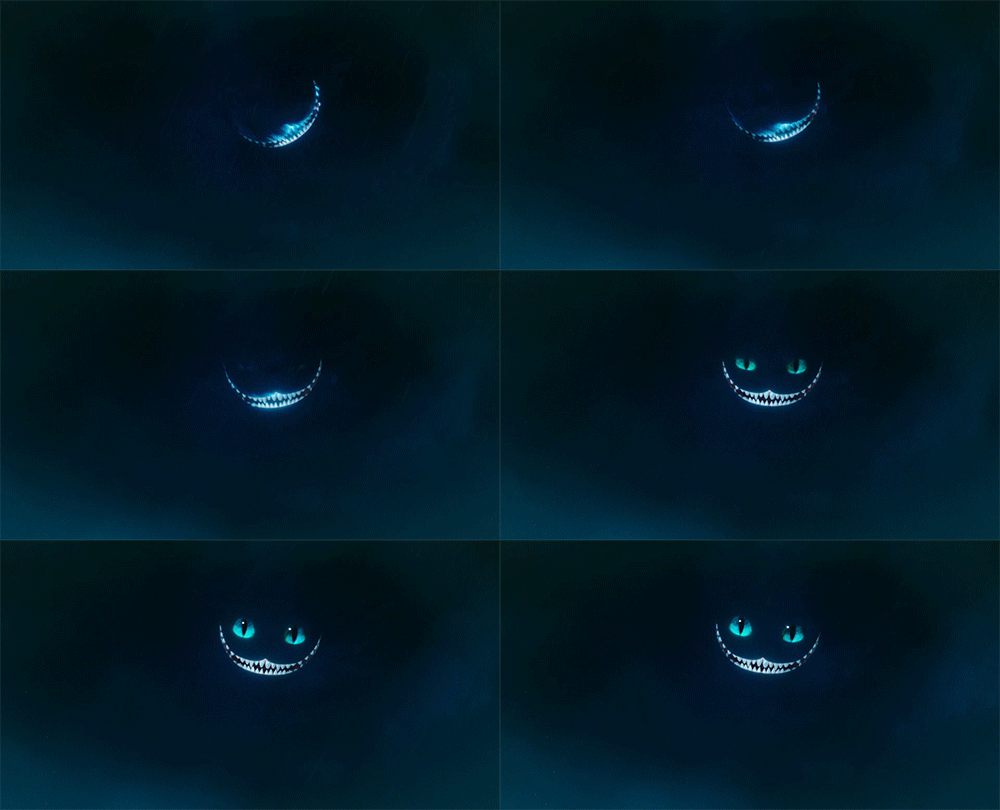
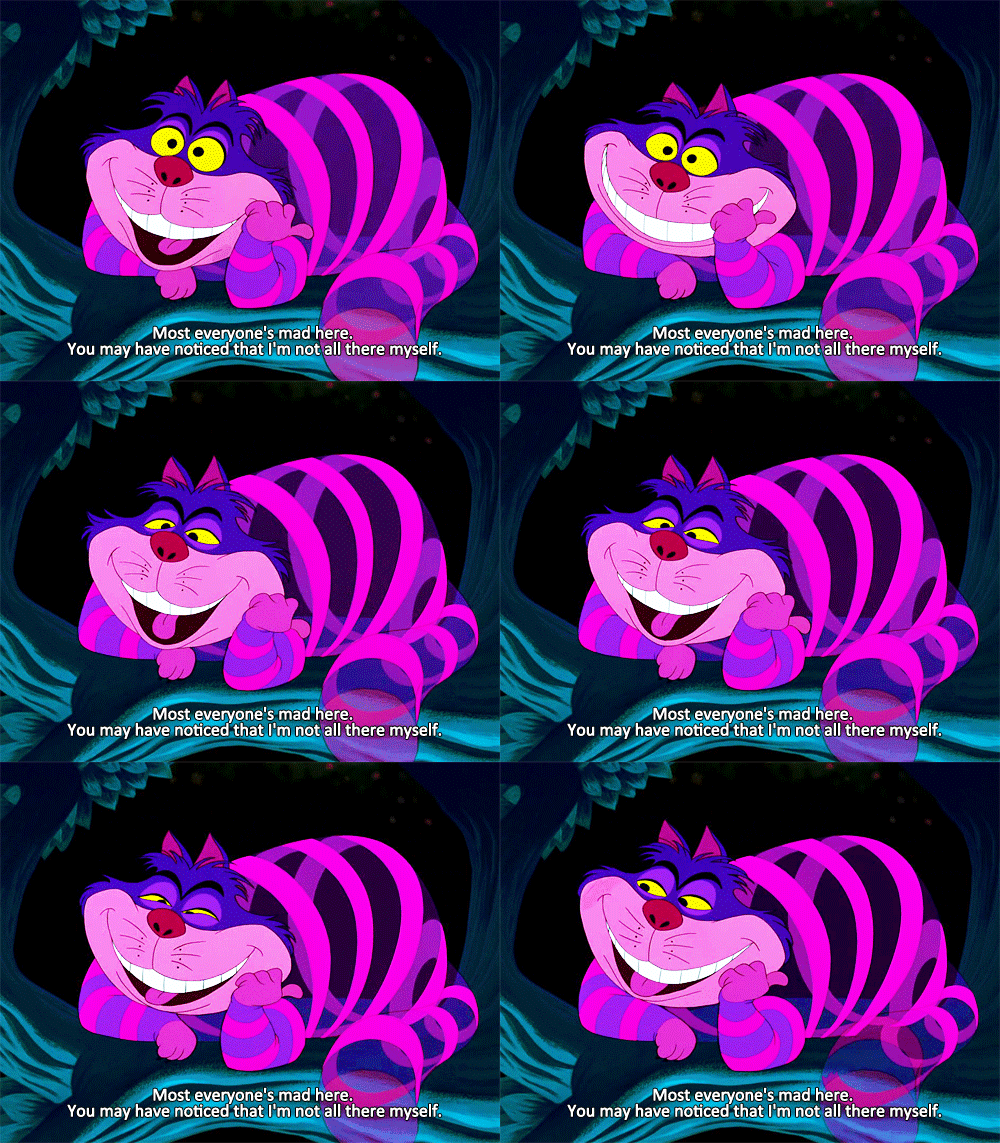
This is the strength of the Cheshire Cat.
Let’s take a look at Cheshire Cat, shall we? At the outset of Alice’s journey in Alice in Wonderland, the audience is led to believe that Cheshire is a sort of ally of Alice’s. Harkening back to the Scarecrow of Wizard of Oz, he points our distressed heroine in the right direction – or so we believe. As every good villain does, Cheshire allows us to believe that, despite his unsettling quirks, he means our damsel well.
Despite this, once Alice reaches her destination at the Queen of Hearts’ Castle, Cheshire causes all sorts of chaos, from exposing the Queen’s bloomers to insulting the Queen on behalf of Alice. On one hand, his actions almost cause the death of the heroine. On the other hand, Cheshire’s intention appears not to be to doom Alice, but rather to simply stir up some trouble, make a little mischief, cause everyone to be just as mad as he himself is.
When writing antagonistic characters, we must ask ourselves: what is the intention behind their actions? Do they loathe those they impede, or do they hold simpler intentions? By no means must these intentions need be pure: Cheshire’s wish to upset the fragile balance of Wonderland certainly does not seem noble by any means. However, that does not mean their intent is to harm the protagonist. The protagonist is but a pawn to them, a means to an end. In some cases, their “toys” are but obstacles to push about the playing field until they reach their goal.
If Cheshire were a Dungeons and Dragons character, his alignment would likely fall much more along the lines of “Chaotic Neutral” than any sort of “Evil”. Despite this, he poses a serious threat to our heroine. So, is he a villain? A hero? A mentor gone wrong? Or does he exist somewhere in the middle: an entity without classification? Sure seems fitting for one such as he, no?
As authors, we must remember that not all enemies wish our heroes harm. Some people seek to manipulate the protagonist. Some seek only their own gain, whether it be helping the protagonist (even temporarily), or turning against them – or both, at different times. These people are not evil, nor should they be treated as such. Misguided? Maybe. Remember to fill your world with enemies of all sorts – not solely those wishing for world domination and the death of benevolence.
Guys, this is really important. Until now, Google collected your data, but did not attach your name to it. Now, they can, and will. This new thing they’re doing will allow them to collect your data across searches, your email, Youtube, Maps, Google+, and all their affiliates, and build a complete profile of YOU.
If that doesn’t bother you, maybe this will: they own and can sell all that data, including anything you create and send (artists and writers, take note).
There is a way you can opt out of this ridiculousness. It’s described in the link, but if you’re still not sure about it, please ask me and I’ll guide you through how to turn all this off.
This is my wake-up call. I’ll be locking down my devices and scaling back what I put through the big Google machine, which means you may see less of me across social media. I’m going to keep researching this, but it may mean in order to keep the rights to my creative work, I’ll have to keep it out of Google’s hands. And that may take some doing.
Duckduckgo is a nontracking search engine….may be worth a try.
So according to the article there is an opt out for this. Instructions are I the last paragraph. I’m on mobile so I’ll edit this more later. EDITED TO INCLUDE OPT OUT INSTRUCTIONS
To opt-out of Google’s identified tracking, visit the Activity controls on Google’s My Account page, and uncheck the box next to “Include Chrome browsing history and activity from websites and apps that use Google services.“ You can also delete past activity from your account.
I don’t mean to impose a personal favour on you guys, but I really would like to ask that everyonewho follows me reblog this.
I don’t think I made it very clear but last month I was sexually assaulted by someone who I thought was my friend (I don’t want to talk about it don’t ask), and it’s… really fucked with my head.
Had I known this a month ago I would have been able to get away.
So, essentially, I’m really pleading with you to reblog this so everyone who follows you doesn’t get stuck in the same position I was with no way out.
I mean again I don’t want the point of this to be my sob story or whatever but if you could reblog this it would seriously mean a lot
and im asking to all of my followers who see this post in your dashboard to please press play to this video, you never know when this is gonna be
useful, PLEASE DON’T IGNORE IT.
This is one of the first moves I was taught in Krav Maga, and it is one of the most effective.
It took me about a half hour to get down with practice, but once you get it, it’s an intuitive movement.
Please pass this along, it will save lives.
Important
Please reblog this.
Please, if you see this, Reblog it.
If you see this, reblog please.
not witchy but definitely worth watching, stay safe
These are from a wonderful book called The Art Of Comforting. Check it out and learn how to be better at supporting people going through difficult things.
If you have the ability to pay for it, are close enough to one, and can get transport there and back a lot of grad schools that have psych programs offer therapy for cheap so that the students can get in the hours they need. University of Louisville for example offers therapy for $15 a session.





 Rambles & Rabble