– A lot of questions I receive revolve around editing and proofreading, so I decided to make an extensive guide to editing your own writing. I collaborated with some amazing friends on this post so this is dedicated to them as well as all of you. I hope you find it useful. Enjoy!
Know The Difference: Editing vs. Proofreading
Editing is about the content, proofreading is about the technical detail and accuracy. Once you know the difference and you separate the two into different tasks, going through and actually doing it will seem less daunting. Deciding which to tacking first depends on what you’re like when you edit, but if you struggling with focusing on actually improving the content because you get distracted by grammatical errors and spelling mistakes, then proofreading first may be a good idea.
Be Intentional With Your Vocabulary
Avoid adverbs
Be frugal with unique adjectives
Only use dialogue tags when absolutely necessary
Be mindful of overused words
Take the time to find the right words
The words you choose can make all the difference so pay special attention to them.
Just Keep Snipping
A basic rule to editing that people often forget it, if it doesn’t serve a purpose, you should cut it out. A short book that is amazing all the way through is better than a long book that is redundant. Don’t worry about leaving your readers in the dark or not having enough content. As you edit, you’ll find ways and places in which to input more information.
Flow & Rhythm
This is the part where you make sure the writing itself sounds how you want it to. It’s important to read your writing aloud during this stage. Some things to pay attention to regarding flow and rhythm:
sentence length/variation
sentence structure
syllables and how they fit together
how your writing sounds out loud
Eloquence
Say it once and say it clearly. Redundancy bores readers so quickly, so when putting information forward, be clear, concise, and don’t add fluff. You don’t need to write a whole paragraph about how a character feels in a situation. It’s important to give the reader just enough to read between the lines.
Grammar
Common Grammar Mistakes To Look For
Subject-verb agreement errors
Sentence Fragments
Missing Comma After Introductory Element
Misusing The Apostrophe With “Its”
No Comma In A Compound Sentence
Misplaced Or Dangling Modifier
Vague Pronoun Reference
Wrong Word Usage
Run-On Sentence
Superfluous Commas
Lack Of Parallel Structure
Sentence Sprawl
Comma Splice
Colon Mistakes
Split Infinitives
List from here x {Explains these further and more in depth}
Improper Use of Phrases
“could have” not “could of”
“My friends and I” not “me and my friends” {If you take away “my friends” or “I”, or one of the nouns in a sentence in general, the sentence should still make sense}
“I couldn’t care less” not “I could care less”. This should be a no-brainer.
etc.. I could go on.
Familiarize yourself with these common mistakes and avoid making them at all costs. It’s also helpful to have someone read over it and let you know when they find issues with phrases you used. Please be attentive to these mistakes because making them can destroy your credibility as a writer.
Utilize The Senses
If you’re describing something in your writing, you should be slipping in words and little details that appeal to the reader’s senses, When editing, look for opportunities to slip in how a place smells, how a food tastes, how something feels to the touch, etc. It’s unbelievable how much this enhances your story.
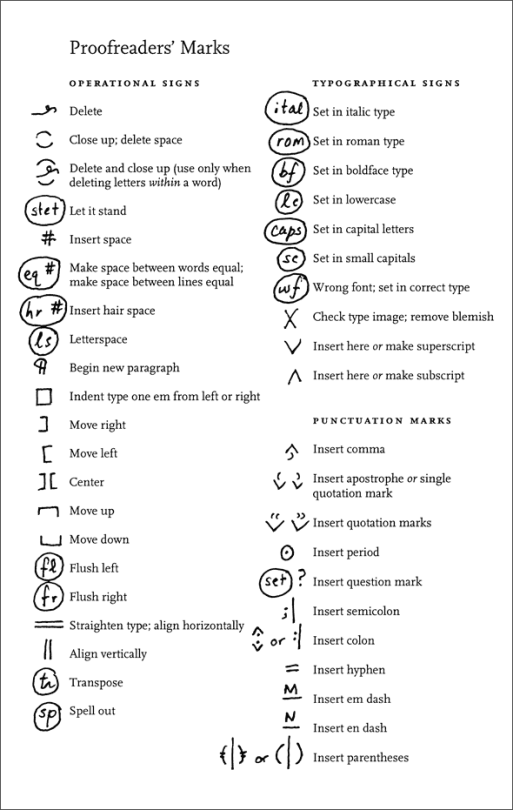
When proofreading and marking up your manuscript, it can save a lot of time and energy if you use marks instead of actually write out everything, so here is a little chart I found that may be useful to you:
Other Things To Look Out For
Make sure you know who is talking
Keep tense consistent
Vary the tone from scene to scene
Run-on sentences
Inconsistencies in story details
Plot holes
Causes and effects of events are explained
Facts and technical details {Make sure you’ve researched them well}
Deviations from established background (know your story really really well and make sure your reader does too)
General Tips
Go in assuming that your work is full of errors. Maybe it’s not, but it’s better to be prepared for the worst and solve the issues now rather than when it’s too late
DO NOT BE SENTIMENTAL. Yes, easier said than done, but it’s possible.
Make the text less recognizable to yourself in order to catch details you may not otherwise.
Print out your manuscript and physically write out the changes.
Read your writing out loud. Sometimes writing looks like it makes sense, but in reality sounds wrong.
Do it in short periods over time so that you don’t inevitably get lazy with paying attention to little details
Keep in mind that editing usually takes longer than actually writing the draft because it is less fluid and requires more thought and problem solving.
Don’t rely on spelling and/or grammar checking software; they’re not always correct and can easily misinterpret what you’re trying to get across.
Check for a single error at a time. It may be time consuming and tedious but it’s more effective than the alternative.
Give yourself time and read slowly through it multiple times
Split up large chunks of text to make it easier to handle. Don’t go through your whole manuscript page by page as if you were just reading it as a book. Go chapter by chapter or scene by scene or even sentence by sentence.
If something seems off, investigate it. Don’t take a chance and leave it be. If you’re stumped, highlight it and have someone else look over it.
Have a strategy. Maybe not at first, especially if you don’t extensively edit your work regularly, but with time you’ll find what works for you and what doesn’t. Create your own system and use it to save yourself some time and confusion.
Change the background colour of the pages to a mint green shade.
It is said that green is a calming colour, however, the main reason why I like this, is because I can write for a much longer period of time now, as a white background I used before made my eyes dry and exhausted after just a few hours of working.
It is basically much more soft and careful to the eyes. I can’t precisely explain why that is. I think it’s that by making a pinch softer contrast of the text and the background, your eyes does not get exposed to as much light.
Just make sure to not make the background too dark, or else your eyes will get exhausted do to over-fixating the lack of contrast between text and background.
And maybe you find a nice pastel/light background shade that fits you; give it a try.
Different things work out and fits for different people. And I just felt like sharing this.
Here’s the shade numbers I used to get my preferred colour:
Thanks for reading.
DUDE
You just solved a very real problem for me! Thanks!
For those who might not know where to find this: It’s in the Page Layout tab.
I made these as a way to compile all the geographical vocabulary that I thought was useful and interesting for writers. Some descriptors share categories, and some are simplified, but for the most part everything is in its proper place. Not all the words are as useable as others, and some might take tricky wording to pull off, but I hope these prove useful to all you writers out there!
i canoodled up a sheet for the different “regular” halo shapes for angels in celestial sphere more for my own reference than anyone else’s
anyways the shape of halo is changed according to what Order an angel is in, and the color is changed to match the color of their Rank. i’m going to go more in-depth with the different Orders of angels later on buuuuut i wanted to get something done today
I compiled most of the writing websites I’ve mentioned on my blog into one post. I find a lot of these sites useful, so hopefully they can help you out!
Imagination Prompt Generator: This give you a one-sentence writing prompt that will help you come up with ideas. I think it also allows you to set a ten minute timer for each prompt.
Wridea: I really like this site because you can write down simple ideas that you can organize later and put into a bigger project. You can share these ideas or the site will help you randomly match ideas. It’s great for brainstorming and building a fully formed outline.
List of Unusual Words — Here’s a site you can browse through that gives you a list of unusual words for every letting in the alphabet. If you’re looking to switch up your vocab, or looking to develop a way a character speaks, this is a good reference.
Picometer — Here’s a writing progress meter that can be embedded on your site or blog. There’s also the Writertopia meter that shows word count/current mood.
Cut Up Machine: This website takes whatever words you typed or pasted into the box and rearranges your sentences. It’s not practical for writing a novel, but it might help with poetry OR coming up with ideas. Experiment with it and see what you can come up with.
Orion’s Arm: This is a great website to use if you want to research worldbuilding or if you have science questions. There are tons of resources you can use.
Word Frequency Counter: If you’re finding that you’re using the same words over and over again, this website should help. You’ll be able to count the frequency usage of each word in your text. This should help you switch up the words you’re using and understand where the problem might be.
Phrase Frequency Counter: This is same site explained above, but it counts the phrases you’re using.
My Writing Nook: This allows you to write or jot down ideas wherever you are. You don’t need to have your laptop in order to access it, so it might help you during this time. You can write as long as you have your phone.
Writer: The Internet Typewriter – This site lets you write, save, share, and/or convert your writing online. I tried it out and it’s pretty cool. It saves for you and is a great way to brainstorm or plan out some ideas.
The Forge – The Forge is a fantasy, creature, spell, and location name generator. It’s awesome.
One Word: This site gives you one word to write about for 60 seconds. This should help you get started with your own writing and will work as a writing prompt to get you warmed up. It’s a great way to get yourself motivated.
Confusing Words: On this site you can search through confusing words that often stump many writers. It’s not a huge reference, but it should help you with some writing/grammar issues.
Cliché Finder: This site allows you to enter parts of your writing and it will search for clichés. If you find that you’re using the same phrases over and over again, this will help a lot. I haven’t messed around with it too much, but it looks useful.
Hand Written Fonts: If you’re looking for great hand written fonts, this is a great reference. All of them are pretty awesome.
Tip of My Tongue — you know when you’re trying to think of a specific word, but you just can’t remember what it is? This site will help you narrow down your thoughts and find that word you’ve been looking for. It can be extremely frustrating when you have to stop writing because you get a stuck on a word, so this should help cut that down.
Personality is the most important thing about your character.
So, whenever I see character sheets, most people just put a little paragraph for that section. If you’re struggling and don’t know what your character should say or do, what decisions they should make, I guarantee you that this is the problem.
You know your character’s name, age, race, sexuality, height, weight, eye color, hair color, their parents’ and siblings’ names. But these are not the things that truly matter about them.
Traits:
pick traits that don’t
necessarily go together. For example, someone who is controlling,
aggressive and vain can also be generous, sensitive and
soft-spoken. Characters need to have at least one flaw that really impacts how they interact with others. Positive traits can work as flaws, too. It is advised that you pick at least ten traits
people are complex, full of contradictions, and please forgive me if this makes anyone uncomfortable, but even bullies can be “nice” people. Anyone can be a “bad” person, even someone who is polite, kind, helpful or timid can also be narcissistic, annoying, inconsiderate and a liar. People are not just “evil” or “good”
Beliefs:
ideas or thoughts that your
character has or thinks about the world, society, others or
themselves, even without proof or evidence, or which may or may not be true. Beliefs can contradict
their values, motives, self-image, etc. For example, the belief that they are an awesome and responsible person when their traits are lazy, irresponsible and shallow. Their self-image and any beliefs they have about themselves may or may not be similar/the same. They might have a poor self-image, but still believe they’re better than everybody else
Values:
what your character thinks is
important. Usually influenced by beliefs, their self-image, their
history, etc. Some values may contradict their beliefs, wants,
traits, or even other values. For example, your character may value being respect, but one of their traits is disrespectful. It is advised you
list at least two values, and know which one they value more. For example, your character values justice and family. Their sister tells them she just stole $200 from her teacher’s wallet. Do they tell on her, or do they let her keep the money: justice, or family? Either way, your character probably has some negative feelings, guilt, anger, etc., over betraying their other value
Motives:
what your character wants. It
can be abstract or something tangible. For example, wanting to be adored or wanting that job to pay for their father’s medication.
Motives can contradict their beliefs, traits, values, behavior, or
even other motives. For example, your character may want to be a good
person, but their traits are selfish, manipulative, and narcissistic.
Motives can be long term or short term. Everyone has wants, whether they realize it or not. You can write “they don’t know what they want,” but you should know. It is advised that you
list at least one abstract want
Recurring Feelings:
feelings that they have
throughout most of their life. If you put them down as a trait, it is
likely they are also recurring feelings. For example, depressed,
lonely, happy, etc.
Self Image:
what the character thinks of
themselves: their self-esteem. Some character are proud of themselves, others are
ashamed of themselves, etc. They may think they are not good enough,
or think they are the smartest person in the world. Their self-image
can contradict their beliefs, traits, values, behavior, motives, etc.
For example, if their self-image is poor, they can still be a
cheerful or optimistic person. If they have a positive self-image,
they can still be a depressed or negative person. How they picture themselves may or may not be true: maybe they think they’re a horrible person, when they are, in fact, very considerate, helpful, kind, generous, patient, etc. They still have flaws, but flaws don’t necessarily make you a terrible person
Behavior:
how the character’s traits,
values, beliefs, self-image, etc., are outwardly displayed: how they
act. For example, two characters may have the trait “angry” but
they all probably express it differently. One character may be quiet
and want to be left alone when they are angry, the other could
become verbally aggressive. If your character is a liar, do they pause before lying, or do they suddenly speak very carefully when they normally don’t? Someone who is inconsiderate may have issues with boundaries or eat the last piece of pizza in the fridge when they knew it wasn’t theirs. Behavior is extremely important and it is advised you think long and hard about your character’s actions and what exactly it shows about them
Demeanor:
their general mood and
disposition. Maybe they’re usually quiet, cheerful, moody, or
irritable, etc.
Posture:
a secondary part of your character’s personality: not as important as everything else. It is advised you fill this out after. Posture is how the character carries themselves. For example, perhaps they swing their arms and keep their shoulders back while they walk, which seems to be the posture of a confident person, so when they sit, their legs are probably open. Another character may slump and have their arms folded when they’re sitting, and when they’re walking, perhaps they drag their feet and look at the ground
Speech Pattern:
a secondary part of your character’s personality: not as important as everything else. It is advised you fill this out after. Speech patterns can be words that your character uses frequently, if they speak clearly, what sort of grammar they use, if they have a wide vocabulary, a small vocabulary, if it’s sophisticated, crude, stammering, repeating themselves, etc. I personally don’t have a very wide vocabulary, if you could tell
Hobbies:
a secondary part of your
character’s personality: not as important as everything else. It is
advised you fill this out after. Hobbies can include things like
drawing, writing, playing an instrument, collecting rocks, collecting
tea cups, etc.
Quirks:
a secondary part of your
character’s personality, not as important as everything else. It is
advised you fill this out after. Quirks are behaviors that are unique
to your character. For example, I personally always put my socks on
inside out and check the ceiling for spiders a few times a day
Likes:
a secondary part of your
character’s personality, not as important as everything else. It is
advised you fill this out after. Likes and dislikes are usually connected to
the rest of their personality, but not necessarily. For example, if your character likes
to do other people’s homework, maybe it’s because they want to be appreciated
Dislikes:
a secondary part of your
character’s personality, not as important as everything else. It is
advised you fill this out after. Likes and dislikes can also
contradict the rest of their personality. For example, maybe one of
your character’s traits is dishonest, but they dislike liars
History:
your character’s past that has
key events that influence and shape their beliefs, values, behavior,
wants, self-image, etc. Events written down should imply or explain
why they are the way they are. For example, if
your character is distrustful, maybe they were lied to a lot by their
parents when they were a child. Maybe they were in a relationship for
twenty years and found out their partner was cheating on them the
whole time. If their motive/want is to have positive attention, maybe their parents just didn’t
praise them enough and focused too much on the negative
On Mental and Physical Disabilities or Illnesses
if your character experienced a trauma, it needs to have an affect on your character. Maybe they became more angry or impatient or critical of others. Maybe their beliefs on people changed to become “even bullies can be ‘nice’ people: anyone can be a ‘bad’ person”
people are not their illness or disability: it should not be their defining trait. I have health anxiety, but I’m still idealistic, lazy, considerate, impatient and occasionally spiteful; I still want to become an author; I still believe that people are generally good; I still value doing what make me feel comfortable; I still have a positive self-image; I’m still a person. You should fill out your character’s personality at least half-way before you even touch on the possibility of your character having a disability or illness
Generally everything about your character should connect, but hey, even twins that grew up in the same exact household have different personalities; they value different things, have different beliefs. Maybe one of them watched a movie that had a huge impact on them.
Not everything needs to be explained. Someone can be picky or fussy ever since they were little for no reason at all. Someone can be a negative person even if they grew up in a happy home.
I believe this is a thought out layout for making well-rounded OCs, antagonists and protagonists, whether they’re being created for a roleplay or for a book. This layout is also helpful for studying Canon Characters if you’re looking to accurately roleplay as them or write them in fanfiction or whatever.
I’m really excited to post this, so hopefully I didn’t miss anything important…
If you have any questions, feel free to send a message.
Hey guys! As a writer myself, it’s hard to have a lot of resources for writing in one place. That’s why I decided to create this masterpost, and maybe make more if I find future resources. I hope you like it, and expect to see more masterposts like this in the future!
ZenPen: A minimalist writing website to keep you free of distractions and in the flow.
The Most Dangerous Writing App: A website where you have to keep typing or all of your writing will be lost. It helps you keep writing…kind of. You can choose between a time or word count limit!
Evernote: An online website where you can take notes and save the product to your laptop and/or smartphone!
Writer, the Internet Typewriter: It’s just you and your writing, and you can save your product on the website if you create an account.
Wordcounter: A website to help check your word and character count, and shows words you’re using frequently.
Monospace: An Android app for writing on the go when you feel the inspiration, but you don’t have your laptop on you!
For Productivity
Tide: An app that combines a pomodoro-esque timer with nature sounds and other noises! (Google Play / Apple Store)
ClearFocus: An Android app with a pomodoro-type time counter to let you concentrate easier and stay productive.
Forest: An app with a time counter to keep you focused and off your phone, and when you complete the time limit, a tree grows in your garden! (Google Play / Apple Store)
SelfControl: A Mac downloadable app that blocks you from distracting mail servers, websites, and other things!
right so, i want to write, but i don’t want to write a full scenario so i decided to compile a list of semi-smutty/slightly suggestive sentences/phrases and i’ll write a drabble that isn’t smut,,, but is suggestive, ya feel? anyways, pick a number and a member and i’ll write a short lil’ suggestive drabble for you. : ) also these were compiled from multiple sources so thanks for your creative minds.. i’ll probably end up adding some more eventually, but this is it for now.
“Do you ever think that we should just stop doing this?”
“H-how long have y-you been standing there?”
“I had to see you again.”
“I don’t need you. I’ll do it myself.”
“I missed you.”
“Is that supposed to scare me?”
“Are you jealous?”
“What are you afraid of?”
“Do you trust me?”
“You weren’t supposed to hear that.”
“It’s not nearly as bad as it looks, Darling.”
“Come over here and make me, then.”
“Is there a reason you’re naked in my bed?”
“It’s not what it looks like.”
“Can you reach it?”
“But you keep using all the hot water!”
“You have a problem, it’s only my job to help you fix it.”
“Baby, I’m on the phone.”
“Keep your voice down.”
“You heard me. Take it off.”
“That… Well I have no idea what that is or where it came from.”
“Your hair’s all messed up. Let me fix it.”
“I can’t sleep.”
“Go then, leave! See if I care!”
“Wanna bet?”
“That’s… Not mine?”
“I’m not going to change. You’ll have to deal with it.”


 Rambles & Rabble