think about these things when you’re making a fictional place; even a developed city has its roots in how easy it was to settle in the first place!
- this site has additional info, diagrams, worksheets, and models, as well as information on things like coasts, volcanoes, and populations
- look at real life sources for climates. Consider the way that your continent(s) lay in relation to their equator, and the weather and types of flora and fauna and peoples that adapted to it.
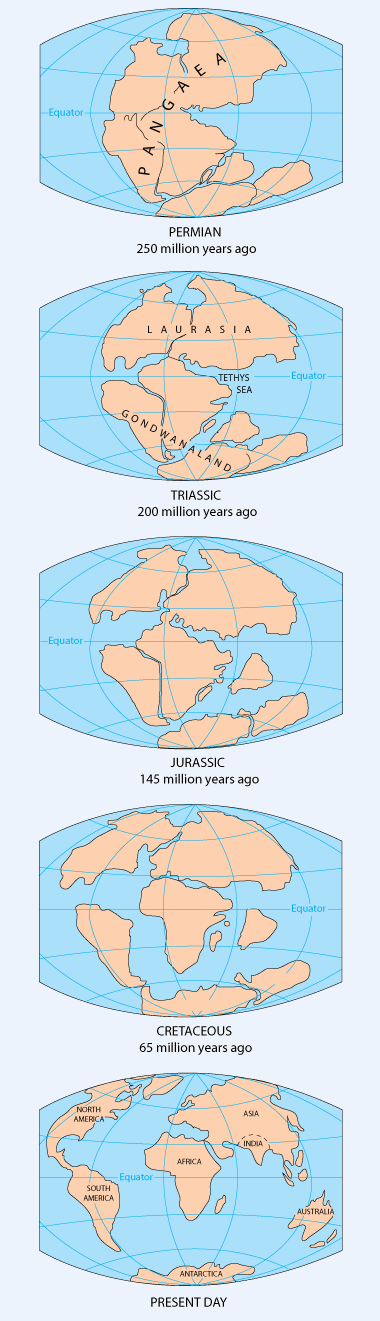
- think about pangea. If you have multiple continents, do they fit together like a jigsaw?
- when in doubt, look at the natural world around you and think about what would change if something was drastically different. Look at the reactions between parts of our world and change them.
- play civilization games and think about the things that go into making decisions there

MUSIC TO INFLUENCE YOU TO WRITE
Feel like you need a song to influence you to write a scene or character? Here are a list of Playlists and Songs you can listen to to get you going!
HAPPY BASED
- When Everything is Wrong and you need a pick-me-up
- a bunch of songs that make me Legit Happy!!
- Carried Away
- Stutter
- Some Days they Taste Like Lemonade
- Picking Up the Pieces
- Keep Your Head Up
- It’s Time to Begin, isn’t it?
- Endless Cheesin
- Free Yourself
- Undertone
SEX SCENES
- lets do it (lets fall in love); a playlist for an old-fashioned love affair
- Songs to fuck to
- Between Two Points
- Erotic Moments
- Nice and Slow
- Breathe My Name
- We Had a Promise Made
- The Only Sex Playlist
- Skin & Bones
- A Forever Love
SAD SCENES/ HEARTBREAK
- Hello My Old Heart
- Shelter
- See all my dreams die
- We All Feel Lost Sometimes
- Whispers Wasted in the Sand
- Time to Study
- One of those Sad Days
- Sad Sad Songs
- Goodnight Moon
- When I Run Through the Deep Dark Forrest
PSYCHOPATHIC CHARACTER/SUSPENSE SCENE
- [MADNESS;] | a playlist to get in the insane muse for your character
- The Devil Within Digital Daggers
- Villains and Demons
- Lose Your Soul
- Savage Desires
- I’ll Be Dead Before the Day is Done
- A Killer’s Symphony
- Murder He Says
- A Boy’s Best Friend
- In a Stranger’s Dream
BADASS CHARACTERS/ACTION-FIGHT SCENE
- Not Your Regular Damsel in Distress
- Biting Down
- Light it Up
- This is it, the Apocalypse
- I Pretend I’m a Bad Ass
- There is No Reconciliation
- Shit to Fuck Shit Up to
- Run
- Let’s Go Hunting
- Cancel the Apocalypse
- Red Lipstick and a Black Jacket
INSTRUMENTAL/ CALM
health, food and exercise resources for nerds who weren’t taught this
Reblogging to read later

Here are some great voice words for when you can hear something in your head and just can’t think of the best way to describe it!

Hello, writerly friends~ ♥︎
My Writing Advice Masterpost is back! Now featuring the best questions and answers from the last three years, along with all of the videos from my writing advice YouTube Channel!
This post will be updated every week with new writing advice videos, playlists, and responses! So, make sure to bookmark THIS page and follow my blog (maxkirin.tumblr.com) so you don’t miss a thing!
Writing Advice Compilations
- The NaNoWriMo Survival Guide
- M. Kirin’s NaNoWriMo 2014 Writing Advice Videos
- WRITERS UNITE! A book of writing advice, inspiration, and tips! Written with the help of 248 Tumblr authors. FREE DOWNLOAD!
Writing Exercises & Prompts
- Virtual Writing Academy (Newest Episode: Writing Exposition)
- Daily Story Seed
- Daily Weird Prompt
- Daily Character Question
- Your Writing Horoscope (Retired)
- “Can I publish a story based on one of your prompts?”
- Did you know that I have published a book of Story Seeds? Sounds interesting? You can learn more about it HERE! c;
Motivation & Inspiration
- Daily Writer Positivity
- How to Regain the Motivation to Finish Your Novel (Video)
- How to Finish Your First Novel (M. Kirin’s Origin Story)
- M. Kirin’s Top 3 Tips for NaNoWriMo
- The 7 Cardinal Rules of Writing Life
- Neil Gaiman’s “Make Good Art” Speech
- Neil Gaiman’s 8 Rules of Writing
- Elizabeth Gilbert’s Inspirational Speech on the ‘Genius’
- What Confidence Is and Is NOT
- “I’m afraid writing is a waste of time”
- “I’m half-way through this book and I’m stuck”
- Stop Trying to Impress People
- Stop Trying to Make Your Parents Proud of your Writing
- Your Parents Disapprove of Your Writing?
- You’re Not The Worst Writer In The World
- English Not Your First Language? Neither is Mine
- Are You Worried Nobody Will Take You Seriously?
- Dealing with Hate and Harsh Criticism
- Why You Need to Develop a Thick Skin
- Feeling Down About Your Writing?
- “I am not as good as other writers” (and other lies)
- Be A Little Delusional
Planning, Outlining, and Getting Started
- How to Plan Your Novel (Video)
- The NaNoWriMo Survival Guide (Video)
- How Much World-Building is Enough? (Video)
- The *Right* Time to be Critical of Your Writing (Video)
- Overcoming the Fear of Getting it “Wrong“ (Video)
- The Story-Idea Test
- M. Kirin’s Click-n-Drag Story Generator
- Which outlining method is the best?
- “I want to write a book but I have no idea where to start”
- M. Kirin’s Secret for Starting books, and Finishing Them
- M. Kirin’s Top 3 Tips to Start Writing and Never Stopping
- Tips for writing Science Fiction, Fantasy, and Paranormal
- M. Kirin’s #1 Tip For Improving Your Writing
- Let’s Talk About: Show VS Tell
- The Difference Between Character & Plot (The Marcy Rule)
Dialogue
- TOP 3 TIPS for Writing Dialogue (Video)
- The Art of Writing Dialogue Tags (Video)
- M. Kirin talks about authentic dialogue
- The grammatical side of dialogue
- How do I write numbers in dialogue?
Editing & Revision
- M. Kirin’s Top 5 Revision Tips
- How to Love and Care for Your Beta Readers
- M. Kirin’s (subjective) secret recipe for the second draft
- When is the best time to edit a story?
- M. Kirin Talks About Editing, and Speeding Up Your Story
- M. Kirin Uses Evernote to Revise Books
- “Kill Your Darlings” VS “Cut What You Love”
- Writing Killer Plot-Twists and Mystery Novels
- “How long is a Rough Draft compared to the Finished Draft?”
Hot-Button Issues
- Let’s Talk About: Filler (Video)
- Let’s Talk About: Purple Prose (Video)
- Let’s Talk About: Deus Ex Machina
- Let’s Talk About: Coincidence in Writing
- Realism is a dirty word
- Racist & homophobic language in fiction
- Inaccuracy in Fiction (Video)
- M. Kirin drops a few bombs on ‘creative vocabulary’
- “I want to write but I don’t have the time”
- Is it bad to have too many LGBTQIA or POC characters?
- “My antagonist is POC/LGBTQIA, is this bad?”
- “All my characters are LGBTQIA, is this bad?”
- When to let go of a story
- Is it rational to be afraid of what people will think of you?
- Let’s Lightly Talk About: Plagiarism & Copyright
- Writing About Things You Have Never Experienced
- “Do you need to go to college/university to be a good writer?”
- My book is similar to something already out, what do I do?
General Advice
- M. Kirin’s Cure For Writer’s Block (and Life Block)
- Overcoming Writer’s Block: The First Sentence (Video)
- A [Strange] Tip For Writing More! (Video)
- Writing Advice from: The Walking Dead (Video)
- World-Building Tips: Dystopian (Video)
- World-Building Tips: Fantasy & Science Fiction (Video)
- World-Building Tips: Life After the Apocalypse (Video)
- World-Building Tips: Government & The Human Element (Video)
- World-Building Tips: Spicing Up The Real World (Video)
- Using Real People as Inspiration (Video)
- When Should The Book End? (Video)
- Writing Better Characters: The ‘Flawed’ Myth (Video)
- Writing Better Characters: Unlikable Protagonists (Video)
- TOP 3 TIPS for Writing a Large Cast of Characters (Video)
- Overcoming the First Sentence (Again) (and Again)
- Let’s Talk About: Pen Names!
- Let’s Talk About: Reactive VS Proactive Characters
- Let’s Talk About: Transitioning Smoothly From Scene to Scene
- Let’s Talk About: Writing The Climax (& Resolution)
- Let’s Talk About: Writing The End
- Let’s Talk About: Spies
- Let’s Make a Title (To A Story You Haven’t Finished)
- The 10-Minute Rule
- Making Boring Scenes FUN to Write!
- Stories are like children
- Let’s Talk About Titles (And Then Talk Some More)
- M. Kirin Reveals the ‘Secret’ Behind Style
- How much description/scenery is too much?
- How can I write faster?
- I want my readers to love my characters
- I think my book may be too short for my genre
- I killed one of my main characters by mistake, what do I do?
- M. Kirin’s Writing Advice for Fleshing out Romantic Relationships
- A warning about character names and meanings
- Past or present tense?
- Is swearing okay? And other muthafuckin’ truths
- “What emotion do you find hardest to write?”
- “What writing software do you use?”
- Communication, a must for collaborative works
- Researching illegal things, cousin? I got just the thing for you!
- Joss Whedon’s Top 10 Writing Tips
- M. Kirin’s Tarot Cheat-Sheet
- Writing Tips for Storytelling in Video-Games
- Fair Use In Novels (by thedancingwriter)
Publishing
Writing Music & Playlists
- Top 10 Songs For Writers
- Writing In The Dark (Unobtrusive)
- Writing About Love
- Writing & Fighting!
- Writing About Horror
- Royalty And Noble Blood (Medieval/Fantasy)
- Digital Reality (Cyberpunk/Futuristic)
- Lost In The Wild (Survival/Nature)
- No Hero (Action/Anti-Heroes)
- Mermaid Magic (Mysterious)
- After The Bomb (Post-Apocalyptic/Dystopian)
- Sorrow (Sad/Despair)
- Upon Black Wings (Adventure/Dragons)
- Haunted Mansion (Horror/Supernatural)
- Childhood Friends (Happy/Uplifting)
- Music For Writers: Portal 2 Soundtrack (FREE)
- M. Kirin’s Favorite Music to Listen to While Writing
- M. Kirin’s Secret For Making Playlists
Miscellaneous
- M. Kirin’s 2014 AMA, Part 1 & Part 2 (Video)
- Max & Kitty Recommend: Top 10 Things You Should Read/Watch/Play Right Now! (Video)
- Finally! An Ask-Meme for Writers!
- M. Kirin’s Philosophy for Running a Writing Blog
Last Updated: 03-07-15. Click HERE to see the latest update. Latest posts are in bold.
how to track anonymous asks.
So you have your ask.
STEP ONE:
Highlight the word “block”
STEP TWO:
Right click the word block.
STEP THREE:
Click “View Selection Source”
STEP FOUR:
Something like this should pop up:
Highlight the “IP” (the blacked out part).
STEP FIVE:
Copy the IP address and paste it to this website:
http://whatismyipaddress.com/ip-lookup
Paste the IP address into there, press enter or “Lookup IP Address” and all the information should come up.If any of you are getting anon hate and you wanna be that extra mile of petty, here you go. Choose your weapon bb. 😘❤️
Bitches you are dead now ahah
Another Fun Fact: if someone’s harassing you online and telling you to kill yourself, that’s equal to jail time! 😀
All you gotta do is find em and tell your local police! ❤️
For thems going through bad times with anon hate
Here u go boo-boos <33
i know a few peeps who could use this im share it haiku robot please
i know a few peeps
who could use this im share it
haiku robot please
^Haiku^bot^0.4. Sometimes I do stupid things (but I have improved with syllables!). Beep-boop!
I dont have hateful anons, but this is cool and valuable infos, reblog!
@jxsontxdds I don’t remember if it was you or someone else I follow that I saw getting a shit ton of anon haye, but I thought you might like to have this
reblogging for those who do + i am always here to talk or help out 🙂
Haha, this is awesome :’D there’s no escape now xD


Writing x Characters When You Aren’t x, A Masterlist
x: a variable used to represent something unknown.
We’ve seen an influx of questions about how to write stories based around characters of color, disability, non-binary, etc. when the author does not fall into these categories. Rather than have these posts take over the site, we’ve decided to compile a list of resources to help our fellow writers become more educated about writing what they do not immediately know. However, this list is not the end-all-be-all of knowledge; one should always try to learn from someone with first hand experience in any topic. The world is constantly growing and changing, and because of that, there will always be more to learn. The admins at Plotline Hotline want to help writers form respectful, informed, and realistic characters that broaden the narrow range we see in literature today.
*Be wary that some of the topics listed below contain sensitive material. Reader discretion is advised.*
As always, the links I found to be especially apt will be in bold. Topics are listed alphabetically, excepting the “other” section.
Culture
Appropriate Cultural Appropriation
What is Cultural Appropriation? [1,2,3]
Cultural Appropriation Is, In Fact, Indefensible
Voice Appropriation & Writing About Other Cultures
Diversity, Appropriation, and Writing the Other
[List]Disability
Writing Disibilities [1,2,3,4,5]
Guides to Writing Deaf or Hard of Hearding People
National Association of the Deaf – Resources [List]
Prostehtic Limbs (Character Guide)
How NOT to Write Disabled Characters
A Guide to Disibility Rights Law (United States)
Timeline of Disibility Rights in the United States
Social Security Disability: List of Impairments, Medical Conditions, and Problems [List] (United States)
How to Write Disabled Characters: An Opinion Piece
Artificial Eye Resources [List][Various]
Adapting to the Loss of an Eye
Misconceptions and Myths About Blindness
Blind Characters: A Process of Awareness
Writing Blind Characters [List]
Types of Learning Disabilities [List]
Diversity
A Guide to Spotting and Growing Past Stereotypes
How to Prepare to Write a Diverse Book
Why Diversity Matters for Everyone
Writing a Driverse Book [1,2,3,4,5]
Diversity, Political Correctness and The Power of Language
Diversity Book List [List][Books]
Basic Tips To Write Subcultures & Minority Religions Better
Gender
GLAAD Media Reference Guide – Transgender
Creating Well-Written Trans Characters
A Few Things Writers Need To Know About Sexuality & Gender Expression
Trans (Character Guide & Bio Building)
A Non-Binary Person’s Guide to Invented Pronouns
Keeping a Trans* Person a Person
Suggestions for Reducing Gendered Terms in Language [Photo]
How to Review a Trans Book as a Cis Person
Writing Characters of Different Genders [List]
Gender Spectrum Resources [List]
Illness
The Spoon Theory – Also pertains to disibility
Sexually Transmitted Diseases [List]
Sexually Transmitted Infections
Sex and Gender Differences in Health [Study]
All Chronic Illness Topics [List]
A Day in the Life of a Home Health Aide/Health Coach
Fiction Books With Chronically Ill Main Characters- Not Cancer [List][Books]
Neurotype (Including Mental Health)
Writing an Autistic Character When You Don’t Have Autism
What to Consider When Writing Mental Illness
Stanford Psychiatric Patient Care
Inpatient Psychiatric Questions and Tips
Don’t Call Me Crazy [Documentary]
(Avoid) Romanticizing Mental Illness [1,2]
A Day in the Life of a Mental Hospital Patient
State-run vs. Private Mental Hospitals
Mental Hospital Non-Fiction [List][Books]
National Institute of Mental Health – Mental Health Information [List]
Remember, Remember: The Basics of Writing Amnesia
What is a Learning Disability?
Race
Writing Race: A Checklist for Authors
Transracial Writing for the Sincere
Is my character “black enough”
White Privilege: Unpacking the Invisible Knapsack
Challenge, Counter, Controvert: Subverting Expectations
Writing With Color: Blogs – Recs – Resources [List]
Writing People of Color (If you happen to be a person of another color)
7 Offensive Mistakes Well-Intentioned Writers Make
Description Guide – Words for Skin Tone
Religion
Religion in Novels: Terrific or Taboo?
How to Write a Fantasy Novel that Sells: The Religion
Writing About Faith And Religion
From Aladdin to Homeland: How Hollywood Can Reinforce Racial and Religious Stereotypes
Sexuality
Understanding Sexual Orientation and Gender Identity [List]
Writing Gay Characters [1,2,3]
American Civil Liberties Union – LGBT+ Rights
LGBT+ Rights by Country or Territory
LGBT+ Studies Web Sites [List]
Overview of Gay and Lesbian Parenting, Adoption and Foster Care (United States)
Other
How Doctors’ Offices—and Queer Culture—Are Failing Autistic LGBTQ People
Five Traps and Tips for Character Development
Developing Realistic Characters
I hope that this list will provide topics a writer may not initially think to research when writing. If there are any resources that you think would be fitting for this list, please let us know! We want to have as many helpful sources as possible to maximize learning opportunities.
Stay educated,
xx Sarah

belt:
I like to have white or ambient noise playing while I study, so I thought I’d share a list of my favourite websites in case anyone else was interested.
- Rainymood – Allows you to play rain, with suggestions of ambient music to play at the same time. Has an iOS and Android app, my personal favourite.
- Calm – A visually beautiful website. Provides moving backgrounds and an option for guided calm which allows you to immerse yourself in the music and to relax. Has a free app for iPhone. Another one of my favourites.
- Showertime – The experience of taking a shower without the water. Allows you to control features such as length of shower, size of room, water pressure, etc.
- Coffitivity – The background noise of a coffee shop. Allows you to choose between different locations such as lunchtime lounge, morning murmur etc. Has an app for iOS and Android as well as a desktop app for OS X.
- Soundrown – A website with a sleek minimalist design, allows you to choose between rain, coffee shop, ocean, fire, bird noises, or a combination of the five.
- Relaxing Snow – Visually beautiful falling snow, the website gives you the opinion to play music with the scenery, or to choose your own.
- Raining.Fm – This website gives you the ability to adjust the rain to exactly how you’d like it, with options to tweak thunder, rain and storm noises. Has an app for iOS and Android, as well as a timer and snooze option.
- Rain For Me – Simple rain effects with the option to download the audio files for offline listening.
- Snowy Mood – Inspired by Rainy Mood, this website really makes you feel like it’s winter. Perfect for playing while snuggled up in a warm bed.
- Rainy Cafe – Combines the sounds of a bustling cafe setting with the sounds of drizzling rain. Allows you to select the volume of each setting, or turn one off completely.
NaNo Character Week: Your Secondary Character Resources
Welcome to day ten of WC’s NaNoPlanMo! Today’s focus is secondary characters!
What Are Secondary Characters?
Secondary Characters With Their Own Needs
The Importance of Supporting Characters
K.M. Weiland: The Major Role of Minor Characters
Secondary Character Creation
Creating Stunning Side Characters and (Why They Matter)
Writing Supporting Characters that Matter
How to Write Effective Supporting Characters
Your Guide to Creating Secondary Characters
Your Map to Creating a Memorable Minor Character
Wendig’s Guide to Creating Super Awesomepants Supporting Characters (Warning: Crass)
Secondary Character Archetypes
DIY MFA: 5 Archetypes for Supporting Characters
DIY MFA: Three Major Roles of Minor Characters
Importance of Secondary Characters (Secondary Character Roles)
K.M. Weiland: 8 ½ Character Archetypes You Should Be Writing
Miscellaneous Tips
10 Secrets to Creating Unforgettable Supporting Characters
K.M. Weiland: 3 Ways to Write Stupendous Supporting Characters
K.M. Weiland: 5 Steps to Writing Minor Characters That Dazzle
Top 10 Tips for Writing Memorable Minor Characters
6 Tips for Writing Minor Characters
Minor Characters Don’t Need Major Introductions

Happy Birthday, Janet Fitch, born 9 November 1955
Janet Fitch’s Top 10 Writing Tips
1. Write the sentence, not just the story
Long ago I got a rejection from the editor of the Santa Monica Review, Jim Krusoe. It said: “Good enough story, but what’s unique about your sentences?” That was the best advice I ever got. Learn to look at your sentences, play with them, make sure there’s music, lots of edges and corners to the sounds. Read your work aloud. Read poetry aloud and try to heighten in every way your sensitivity to the sound and rhythm and shape of sentences. The music of words. I like Dylan Thomas best for this–the Ballad of the Long-Legged Bait. I also like Sexton, Eliot, and Brodsky for the poets and Durrell and Les Plesko for prose. A terrific exercise is to take a paragraph of someone’s writing who has a really strong style, and using their structure, substitute your own words for theirs, and see how they achieved their effects.
2. Pick a better verb
Most people use twenty verbs to describe everything from a run in their stocking to the explosion of an atomic bomb. You know the ones: Was, did, had, made, went, looked… One-size-fits-all looks like crap on anyone. Sew yourself a custom made suit. Pick a better verb. Challenge all those verbs to really lift some weight for you.
3. Kill the cliché.
When you’re writing, anything you’ve ever heard or read before is a cliché. They can be combinations of words: Cold sweat. Fire-engine red, or phrases: on the same page, level playing field, or metaphors: big as a house. So quiet you could hear a pin drop. Sometimes things themselves are cliches: fuzzy dice, pink flamingo lawn ornaments, long blonde hair. Just keep asking yourself, “Honestly, have I ever seen this before?” Even if Shakespeare wrote it, or Virginia Woolf, it’s a cliché. You’re a writer and you have to invent it from scratch, all by yourself. That’s why writing is a lot of work, and demands unflinching honesty.
4. Variety is the key.
Most people write the same sentence over and over again. The same number of words–say, 8-10, or 10-12. The same sentence structure. Try to become stretchy–if you generally write 8 words, throw a 20 word sentence in there, and a few three-word shorties. If you’re generally a 20 word writer, make sure you throw in some threes, fivers and sevens, just to keep the reader from going crosseyed.
5. Explore sentences using dependent clauses.
A dependent clause (a sentence fragment set off by commas, dontcha know) helps you explore your story by moving you deeper into the sentence. It allows you to stop and think harder about what you’ve already written. Often the story you’re looking for is inside the sentence. The dependent clause helps you uncover it.
6. Use the landscape.
Always tell us where we are. And don’t just tell us where something is, make it pay off. Use description of landscape to help you establish the emotional tone of the scene. Keep notes of how other authors establish mood and foreshadow events by describing the world around the character. Look at the openings of Fitzgerald stories, and Graham Greene, they’re great at this.
7. Smarten up your protagonist.
Your protagonist is your reader’s portal into the story. The more observant he or she can be, the more vivid will be the world you’re creating. They don’t have to be super-educated, they just have to be mentally active. Keep them looking, thinking, wondering, remembering.
8. Learn to write dialogue.
This involves more than I can discuss here, but do it. Read the writers of great prose dialogue–people like Robert Stone and Joan Didion. Compression, saying as little as possible, making everything carry much more than is actually said. Conflict. Dialogue as part of an ongoing world, not just voices in a dark room. Never say the obvious. Skip the meet and greet.
9. Write in scenes.
What is a scene? a) A scene starts and ends in one place at one time (the Aristotelian unities of time and place–this stuff goes waaaayyyy back). b) A scene starts in one place emotionally and ends in another place emotionally. Starts angry, ends embarrassed. Starts lovestruck, ends disgusted. c) Something happens in a scene, whereby the character cannot go back to the way things were before. Make sure to finish a scene before you go on to the next. Make something happen.
10. Torture your protagonist.
The writer is both a sadist and a masochist. We create people we love, and then we torture them. The more we love them, and the more cleverly we torture them along the lines of their greatest vulnerability and fear, the better the story. Sometimes we try to protect them from getting booboos that are too big. Don’t. This is your protagonist, not your kid.
Janet Fitch is best known for her novel, White Oleander. She is a faculty member in the Master of Professional Writing Program at the University of Southern California, where she teaches fiction.
From Writers Write
 Rambles & Rabble