here’s a thing that i don’t think american kids are told often enough:
STAY AWAY FROM FOR-PROFIT COLLEGES.
ITT tech, virginia colleges, bryant and stratton, the art institutes, university of phoenix, everest, devry, etc – do NOT attend these places. do not give them your money – and it will be a lot of money. They are all, to a one, scams.
For-profit colleges prey on minority, low-income, military, nontraditional, and chronically underemployed students by promising them a quick path to a career. They are lying. They often do not allow the transfer of credits to and from, and many are either unaccredited or accredited by suspect accreditors. They rely on their students to take out massive federal student loan debt. They line their pockets with money from the government and then burden their graduates with tens of thousands of dollars of debt for inadequate education and degrees that aren’t worth the paper they’re printed on.
If you’re a non-traditional student looking for a degree, don’t go to a for-profit. Find a community college in your area instead. most ccs have more flexible class times for especially vocational/technical certifications and quite a few offer online-only or hybrid degrees. Hell, if you’re a non-trad student and you have a GED and some spare cash, try studying for a few months and then taking the SATs/ACT and trying for a four-year straight out (that’s what I did). Or get an AA and then do a four-year. Or look for a technical/adult education program sponsored by a local community college or school district. Just please, please, please, don’t go to a for-profit college. They will ruin your credit rating, your finances, and your job prospects.
To all the writers who have ever been told “Your characters have to be three dimensional!” or “They should be well-rounded!” and just felt like saying: “What does that even MEAN?! What goes into a 3-dimensional character? Specifically? And how do you go about creating one?!”
Good news. There’s a way.
Great main characters – heroes, protagonists, deuteragonist, whatever you want to call them – have ten things in common. Ten things that are easily developed, once you know what to create within your character. So no one will ever be able to tell you “needs to be more three dimensional!” ever again. Ha.
1) Weaknesses: Main characters should be flawed, but I’m not saying this because it will make them more realistic (though it will) – I’m saying they need to be flawed because if they’re not, they shouldn’t be a main character. Story is another word for change, or more accurately, character growth. Not character as in “fictional person”, character meaning “heart and soul”. Story is someone’s character changing, for better or worse. Main characters at the beginning of the story are lacking something vital, some knowledge of themselves, some knowledge of how to live a better life, and this void is ruining their lives. They must overcome these weaknesses, if they’re going to become complete, and reach a happy ending. There are two types of weaknesses: Psychological and Moral. Psychological ones only hurt the main character. Moral ones cause the main character to hurt other people. Easy.
2) Goal: Characters exist because they want something. Desiring something, and the fight against opposition for that desire, is the lifeblood of story; and because character is story, it’s also desire that can breathe life into words on a page, and begin the process of creating a real person in a reader’s mind. It’s this ‘desire for something’ that sparks that first connection between reader and character. It makes us think “Well, now I have to find out if this person gets what they want.” This is a powerful link. (How many mediocre movies do we suffer through, when we could easily stop watching, because we’re still trapped by that question of “what happens?”) So if this is powerful enough to keep people watching an annoying movie, imagine how powerful it can be in an excellent story.
Like in Up, the goal is to get the house to Paradise Falls.
3) Want: If the main character wants something, they want it for a darn good reason. Usually, they think that attaining the goal will fill the void they can sense in their lives, the deficiency they can feel, but don’t know how to fix. And they’re almost always wrong. Getting the goal doesn’t help anything; which is why, while pursuing that goal, they discover a deeper need that will heal them. Which brings us to …
4) Need/Elixir: Main characters are missing something, a weakness in their innermost selves is causing them to live a less-than-wonderful life. Through story, these main characters can be healed. Once they discover what’s missing, and accept it, and change the way they live to include this truth they’ve uncovered … they’re healed. Learning this truth, whatever it is, forms the purpose of the story for the main character. The reader, and the character, think the story is about achieving that big tangible goal the premise talks about; really, underneath it all, the story is about someone achieving a big intangible truth, that will ultimately save their life and future. Often, this need is exactly what the character fears or professes to hate.
Like Finding Nemo, where Dory states exactly what Marlin needs to learn.
5) Ghosts:
Not this kind of ghosts.
Ghosts are events in your character’s past which mark the source of their weaknesses and strengths. Because these happened, the character became who they are. All we need to know about backstory are these moments, because who the character became is all we care about. There’s really only one ghost you absolutely need: the source of their moral and psychological weakness. Something happened that knocked the character’s world off kilter, and everything from that moment onward has been tainted by what happened. This moment haunts them (hence the name), and holds them back from uncovering that need that will heal their weaknesses. Pixar are masters of this: the source of Carl being stuck in the past, curmudgeonly, unable of loving anyone new? Ellie dying; his ghost. In Finding Nemo, the source of Marlin being suffocating, protective to the point of being harmful, possessive, and fearful? His wife and 99% of his children being eaten in front of him; his ghost.
6) True Character: These are the strengths, values, convictions, fears, faults, beliefs, worldview, and outlook on life that make the main character who they truly are.
7) Characterization: This is everything on the surface of a main character. The way they look, talk, act, etc. All of this originates from those deeper elements of their being, the strengths, values, ghosts, weaknesses, needs, that make them who they truly are. So often, you can think of this as a facade they’re projecting, a way to shield the the truth about themselves, how they wish to be perceived. The story, and the other characters, are slowly going to see deeper than this characterization, revealing more and more of the reasons it is the way it is.
8) Arc: If the character is going to change from “Incomplete Person” to “Complete Person” there’s going to be a journey they go on to make that possible. The external story, the pursuit of that big tangible goal the premise is about, is causing an inner journey to take place. What they have to do in pursuit of that external goal will apply pressure to those weaknesses, and pressure causes change. This process has seven steps, but if I write it all here this post is going to be obscenely long. So I might wait and give this its own post.
9) Changed Person: Who is the character going to be at the end of this story? They better be different, or else the story didn’t work. How do they show how different they’ve become? What is the moral choice they make, that spins their trajectory from “the future doesn’t look so great” to “happily ever after”? This should be known right away, maybe even before anything else is settled about the character. This gives a distinct end goal, a way to work backwards, a destination in mind that you can navigate towards.
10) Fascination and Illumination: The surface characterization, and the brief glimpses of the true character underneath create curiosity in the reader/audience. What the character says, and the implied subtext beneath the dialogue, creates a puzzle the audience wants to solve. Actions they take work the same way; if the writer indicates there’s deeper motivation behind why a character behaves in the way they do, we buy into solving that mystery right away. We can’t help it. “Who are you really? Why are you the way you are? And how is that going to effect the story?” These are all the unspoken, almost not consciously acknowledged, questions that fascinating characters provoke. Searching out meaning, connecting the dots to find the truth – we can’t resist this. We’re not fascinated by tons of backstory and exposition about a character; we’re fascinated by story, by mystery, by the technique of withholding information and having to interpret and hunt out the truth on our own. So gradually, the story and the characters will force that character to reveal a little more, and a little more, until we have a complete picture of who this person is. Crucial that this information isn’t told up front. Gradually illuminate it. It’s just like getting to know a real person.
So how does this work in a real character? Let’s take a look at Flynn Rider/Eugene Fitzherbert, because almost everybody has seen that movie.
Moral Weaknesses: He’s selfish. He’s a little greedy. He’s a little rude. He uses his charisma and bravado to keep people at a distance from the real him.
Psychological Weaknesses: Insecurity, fear of vulnerability, feels like the real him (Eugene) would be unwanted, unlovable, and have nothing – just like when he was an orphaned kid. Also, he doesn’t know who he wants to be, what he wants to live for.
Goal: Flynn wants to get that crown. So he has to get Blondie to see the floating lights, so she’ll give it back to him, and then they can part ways as unlikely friends.
Want: Why does he want the crown? What does it mean for him? He actually states it (reluctantly) in song: “I have dreams like you, no really. Just much less touchy feely. They mainly happen somewhere warm and sunny. On an island that I own, tanned and rested and alone. Surrounded by enormous piles of money.” He senses there’s something off in his life, something is missing. But he mistakenly believes this missing piece is money, which will allow him to buy a lonely island, where he can live out his days as Flynn and no one will ever know Eugene.
Need: “All those days chasing down a daydream. All those years living in a blur. All that time never truly seeing, things the way they were. Now she’s here, shining in the starlight. Now she’s here, suddenly I know. If she’s here, it’s crystal clear, I’m where I’m meant to go.” He wants a crown … he needs to fall in love with Rapunzel. He needs to love something more than himself, and find out that love isn’t something to fear and push away. He needs to abandon the ‘Tales of Flynnagin Rider’ ambition, and get a more worthwhile, new dream.
Ghost: The source of all of his weaknesses can be linked to his “little bit of a downer” childhood as an orphan. Interestingly, he isn’t aware of another facet of that ghost, and Rapunzel points it out to him. “Was he a thief too?” she asks. He looks taken aback, before answering “Uh, no.” Something’s gone wrong. The choices he’s making are not living up to that original role model.
Characterization: Flynn’s charming, funny, smart, charismatic, and arrogant (in a somehow charming sort of way). He’s also rude, contemptuous, and sarcastic. All traits that help him keep up that ‘swashbuckling rogue’ facade, and push people away from the real him.
True Character: Underneath all that, he’s a Disney prince. That pretty much sums it up.
Changed Person: “Started going by Eugene again, stopped thieving, and basically turned it all around.” He started the story as the guarded and evasive Flynn, he ends as the selfless and thoroughly-in-love Eugene.
Fascination and Illumination: Imagine if everything about Flynn had been told, right up front. We know he’s an orphan, we know he’s upheld a fake reputation, we know he’s a kind and loving guy underneath it all, we even know about his “tales of Flynnagin” childhood dream. You know what happens? We like him … but we’re not interested in him. There’s nothing we need to find out. There’s no curiosity. And if there’s no curiosity, and nothing being illuminated, your story’s not going anywhere. So instead, we find out – alongside Rapunzel – more about Flynn as the story progresses. And that is how it should be.
So!
Developing characters in this way, I’ve found, really reduces worries about how “well-rounded” and three dimensional I’ve made them. They feel real to me. And besides helping me create characters, this ten element technique has also let me analyze characters I like, which is strangely fun. It’s a great way to figure out why a character works, what causes them to be so effective, and how you can go about creating them yourself.
Yeah, I’m a bit of a nerd.
But if you want, try it out. Develop a character. Analyze a character. You might find it as useful/fun as I do.
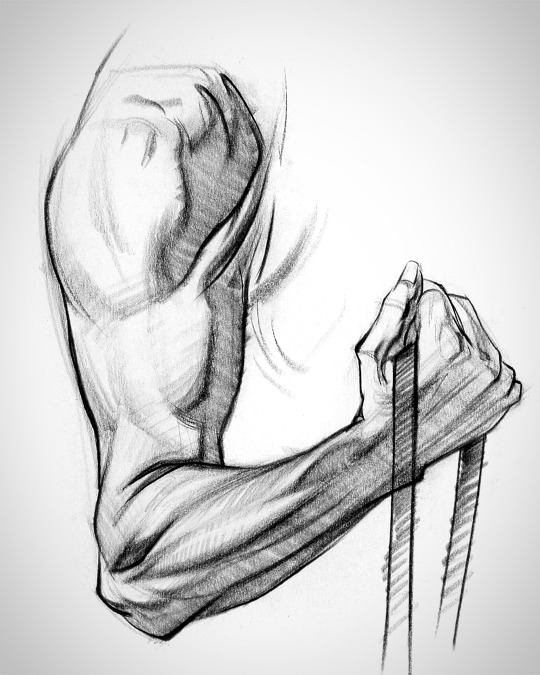
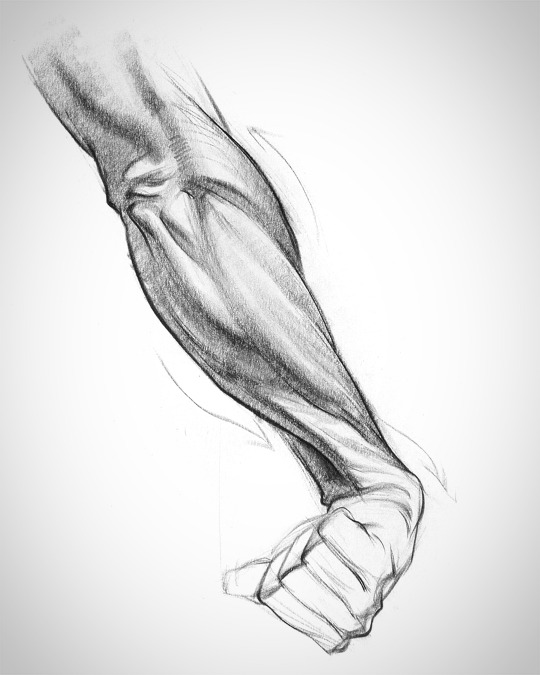
There’s three main groups: the flexors and extensors each take one half of the forearm, and the ridge muscles sit on top like a little tiara. Each group has it’s own unique form. Learning their anatomy will help you design awesomely dynamic arms.
Let’s try to make forearms manageable to draw. This is a body part most artists don’t quite understand. It can be real intimidating if you don’t know the muscles.
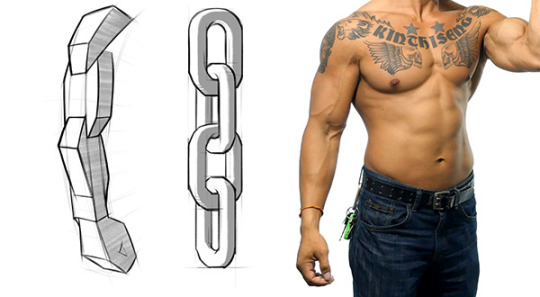
The arm has a simple chain design and the forms interlock down the arm.
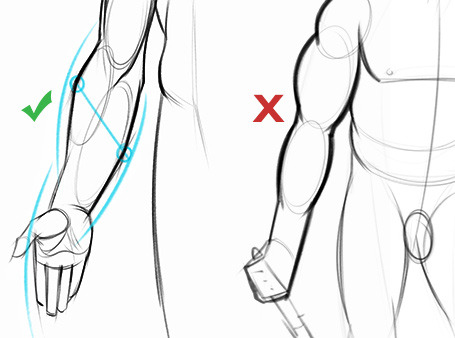
To avoid the snowman effect, use straight, angular lines and look for asymmetries. Compare the apex of both sides of the forearm to understand the curvature better. Notice that the flexors reach lower on the wrist than the extensors and ridge muscles.
Look for this kind of thing when you’re drawing the gesture of the muscle groups. A wave rhythm where the curve on one side leads into the next curve on the other side.
For this, we need to answer the following questions:
What is a plot point? What makes a plot point strong?
In order for something to be a plot point to begin with, it must provide a point within the plot where the story could go in more then one direction. In most situations, it’s the character’s choices (generally those of the main character, though not necessarily) which pick the direction the plot takes from this point.
Looking at a plot point from this angle, we can deduce that the plot has a lot to do with who our character is. This makes sense. Goals are absolutely necessary for almost every story imaginable, because if your character doesn’t want something then you have no plot.
So we have a character who’s striving towards their goal. How do we turn that into a strong plot point? Characters who have goals should also have beliefs, (or in some cases, secondary goals), and these two things must conflict somewhere. Anywhere the character must choose between them, we have a foundation on which to build an interesting, strong plot point. On the other hand, if we don’t have these things, our plot point won’t ever be as strong as it might otherwise have been, no matter how many cool things we throw into it.
So to create a strong plot point we can start with a character who needs to make a choice in order to reach their goal. We make this choice more interesting by throwing road blocks at the character. It might help to ask yourself these sorts of questions:
What can we throw at this character to make them change their choice partway through?
What can we throw at this character which we know will stress them out personally?
What can we throw at this character after they’ve made their choice, which they’ll have to now overcome because of the choice they’ve made?
What sort of consequences will come out of this choice and how do we show them?
And if you’re willing to do some work in order to find a realistic way for your character to get out of the situation: What can we throw at this character which will turn this into their worst nightmare; the most awful possible version of this situation?
Knowing what makes a strong plot point, we can finally answer the question: Are weak plot points really bad?
Plot points with weak foundations are really bad, yes. Weak plot points which don’t revolve around a character making tough choices in order to reach their goals will generally fall flat to readers.
But, not every plot point needs to be a crazy, chaotic mind blowing twist either.
Sometimes the choices we find most emotional and stressful are the ones everyone else tells up should be easy. The key to engaging your reader in a plot point is to convince them that this is emotional and stressful for your character and that your character believes there will be consequences to making a bad choice, and to instill in them the need to know what choice your character will make and what outcome that choice will bring.
tl;dr Plot points don’t have to be unique or fancy or even action-packed in order to engage a reader. They simply need to show a situation where a character the reader is already engaged with has to make a decision which will change the course of the plot.
(Minor Edit: I had a dyslexic moment and read ‘plot points’ instead of simply ‘plot’ five times in a row, so that’s what the answer is specifically about. But since a plot is made of a bunch of plot points with sentimental connecty stuff in between, this is still all the same advice as I would otherwise give. Write some good plot points with solid, emotional foundation and your plot will be sturdy enough to carry a reader through, I promise ^^)
“Art, like morality, consists of drawing the line somewhere.” – G. K. Chesterton
In this week’s lesson, we are going to talk about, as G. K. Chesterton puts it, “drawing the line somewhere.” More specifically – drawing in contour.
In drawing, a contour refers to “an outline, especially one representing or bounding the shape or form of something.” We got a little bit of practice with this when we did the blind contour exercise in lesson two. But in this lesson, I promise, we’ll actually be able to look at what we’re doing (though if you want to go back and give the blind contour exercise another go, it’s never bad practice).
The following are all contour, or linework drawings:
The outline doesn’t refer solely to the exterior outline, such as we’d see framing a silhouette, but also to outlines of interior details, such as folds of cloth or curls of hair. All the information in the drawings is conveyed with line.
[Personal note: the sample drawings above are all mine – as a huge comic book fan since the age of 11, contour-heavy artwork has always been near and dear to my heart, and has become a central component of my personal style.]




 Rambles & Rabble