7 Ways End Your Novel

fictionwritingtips:

Figuring out the right way to end your novel can be difficult and it can make or break your story. If you’re stuck, try to understand that your ending should match the tone of your story. Here are a few common ways to end a novel to keep in mind:

Happy

There’s nothing wrong with a happy ending. If you want your novel to end on a joyful note with everyone getting what they want, that’s perfectly fine. Just make sure it’s in line with how your characters have behaved throughout your novel.

Sad

Writing a sad ending depends on how you built up your novel. A sudden, sad ending shouldn’t come out of nowhere. It should tie in with the tone of your story. If you want to write a sad ending, make sure it makes sense in the world you’ve created.

Open

Sometimes due to the nature of your story, your ending will remain open. Maybe your audience will have to come to conclusions themselves or maybe you’re leading into your next novel. If you’re writing a sequel, writers will often end with it open or a cliffhanger.

Complete

Happy or sad, some writers tend to complete their novel. These means they’ve tied up all loose ends, plots, and subplots, and created a solid ending. Usually this leaves no room for a follow-up and the novel can stand complete on its own. 

Twist

The twist ending can be hard to pull off, but if done correctly it can really blow your readers’ minds. This is when you lead up to one conclusion and then reveal that an assumed truth was false the whole time. Study up on twist endings if that’s something you want to do in your story.

Tie-back

This is when the ending ties back around to the clues in the beginning. Stories with a tie back ending sometimes have a full loop and give the story a feeling of completeness. They make readers feel as if everything is connected in some way.

Epilogue

An epilogue often gives readers details beyond the perceived ending. Writers will sometimes use epilogues if there’s a lot to sum up. Just make sure the epilogue fits your novel and it’s not something you can explain in the main sections of your story.

-Kris Noel

Reasons to Keep Writing

morgannbethh:

everyone starts small. just because you’re not big now, doesn’t mean you’ll never be. and if you’re just starting out, keep in mind those bigger blogs have been writing for much longer than you. building a following takes time. 

there will always be someone who enjoys your writing. every like, reblog, and comment is one person who enjoyed what you wrote and i can assure you they want more! and remember, not everyone remembers to leave evidence that they liked your writing or they might just be too nervous to interact with you. invisible fans exist, and you’ve got them.

going along with that last one, your writing has the potential to help others! you could write about a minority, or maybe you could publish a little something comforting at the exact time someone else needs it. and most of the time, when you affect someone like this they’ll tell you, whether it be through tags, or a private message or whatever. that’s an amazing feeling.

getting a compliment from someone becomes a sure-fire way to make your day better. nothing feels greater than seeing a comment from someone saying how much they love something you worked hard on. maybe write down these comments somewhere, so you can look at them when you’re feeling negative about your skills as a writer.  

writer’s block is not the end of your writing career. it sure feels like it sometimes, but everyone, even the popular writers you look up to, suffer from writer’s block. everyone puts out work they’re not 100% satisfied with sometimes, and that’s okay! when you get out of this slump, your writing will be better than ever before and you’ll enjoy it again. keep writing through a block so you can get there sooner.

These are the things I think about when I feel bad about my writing, so I hope they can help someone else too.

hello! can i ask for a tutorail in hands/arms and legs/feet?

zemael:

Hey! Sorry for the late reply, I haven’t really had time to do the tutorial for you! But, I did one today. It’s kinda messy and not 100% anatomically perfect (I do several flaws myself) but I think I made some good points!
  • Arms:

image

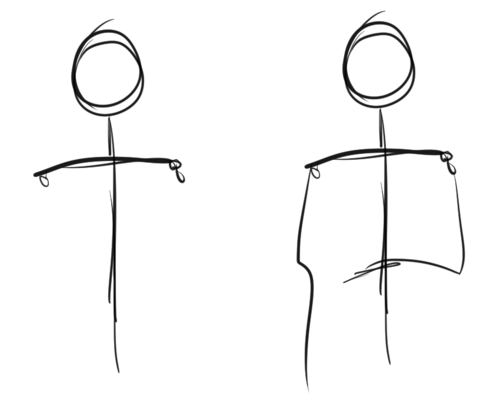
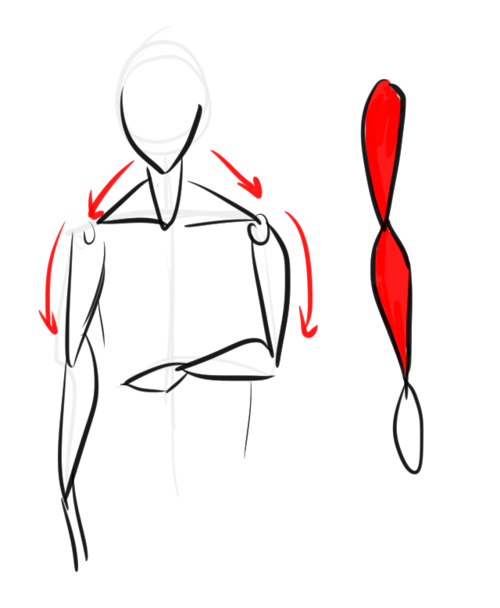
Arms cannot be done without shoulders, so that’s why I will include them here. To know how one body part works, you need to understand the other parts too. I suggest drawing a stick figure, as shown above. Do it with shoulders and everything – don’t care about anatomy. Really, don’t – go mad! You can figure out how to deal with the anatomy AFTER you have figured how to draw the body freely.
image

I imagine most body parts to be shaped as tear drops, as shown above; especially the arms and legs. Draw them above the stick figure – don’t be afraid to overlap the teardrops. In fact, I suggest it! The best way to understand anatomy is to think of it as shapes and doll-parts.
image

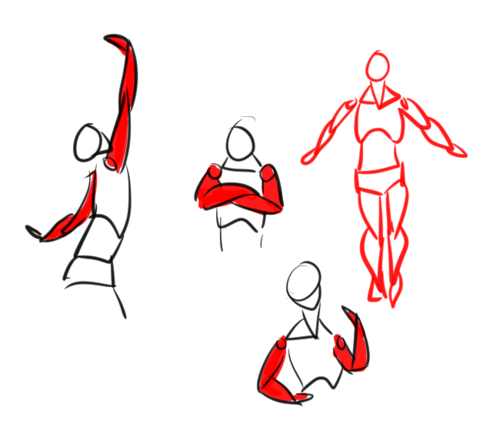
After you’ve figured that out, do several, VERY tiny, small doodles like these. Go crazy – don’t bother with anatomy just yet. Do them also very quickly and so small you can’t think of the details. Just keep doing this until you sorta understand how arms work. 
image

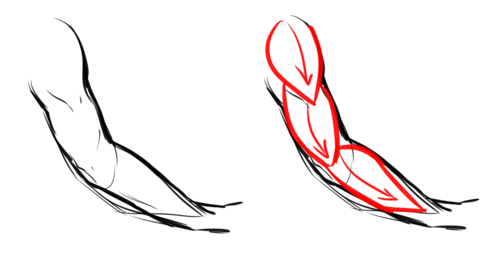
Here is a doodle of a “real” arm, and as you can see, how it’s shaped it resembles the teardrops above. A general rule is to constantly draw the body in curves – male AND female. NEVER draw a single line straight.
image

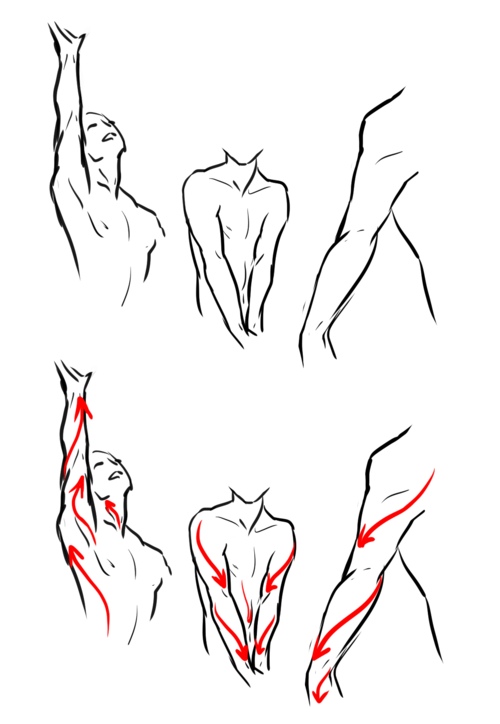
I mentioned before I thought it was important to include shoulders/other body parts to understand another. This is why. The body basically has a “flow” when you move. The red lines clearly shows the flow. This is also how you can create a dynamic pose: think of the flow. The muscles are formed that way to be able to function. Which reminds me, buy some good anatomy books. And I’m talking about more or less MEDICAL anatomy books – you think you won’t need it – but trust me, it’s more useful than you can imagine. I do NOT suggest buying “stylistic” anatomy books, like Christopher Hart (ugh NO), for example, as these can mislead you. Medical anatomy books CANNOT because they MUST be right.
image

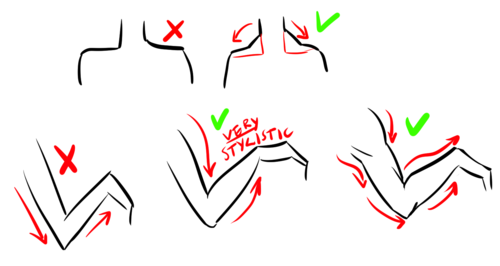
And for the last part, here’s some “do’s” and “don’ts”. It’s important to remember the muscles between the neck and shoulders. Many, especially when drawing females, forget this. It’s true the most visible it is – the more muscular you will look. But even the most petite people have these. Your neck literally would not function if you didn’t have these supporters. Then, the arms below is just to show why it’s important to draw the body with curves. Many have probably heard “straight lines for males” which is a complete lie. They will look stiff and unnatural. Curves can both empathize muscles AND fat. Heck, even your bones aren’t straight.
  • Legs:

image

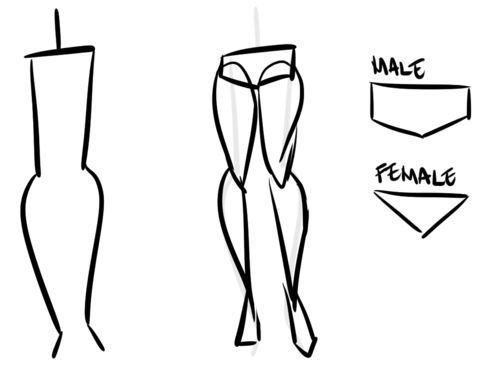
Legs certainly are the hardest. There’s a good reason for this; because they’re one of our most strongest muscles, and they are more or less dominating when it comes to poses (together with the spine). However, just like with the arms, draw a stick figure. I won’t suggest drawing them completely straight, as you can see here, as it will add weight. Do teardrops shapes. As for the hips – think of them as panties or briefs. This is not a MUST; but it will help; I think!
image

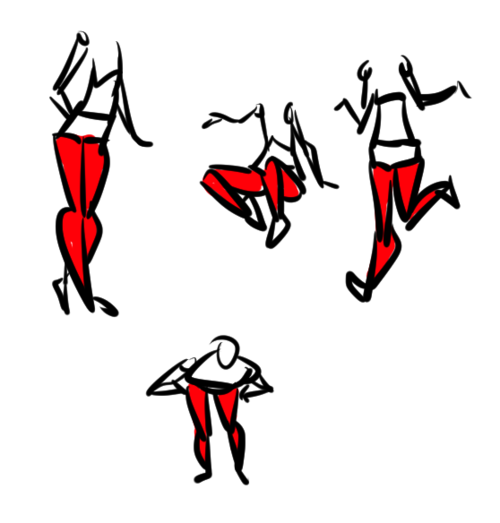
And just like the arms, do small doodles. Don’t be serious, play around until you get the idea.
imageimage

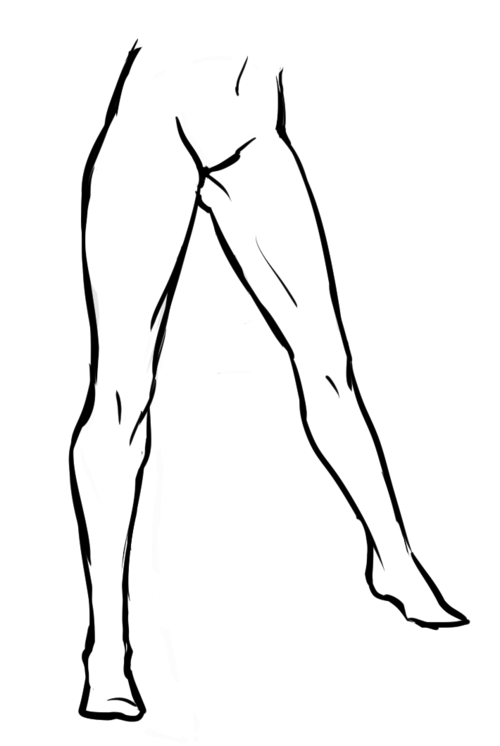
As you can see, these legs easily can be turned into teardrops even when they’re detailed like this.
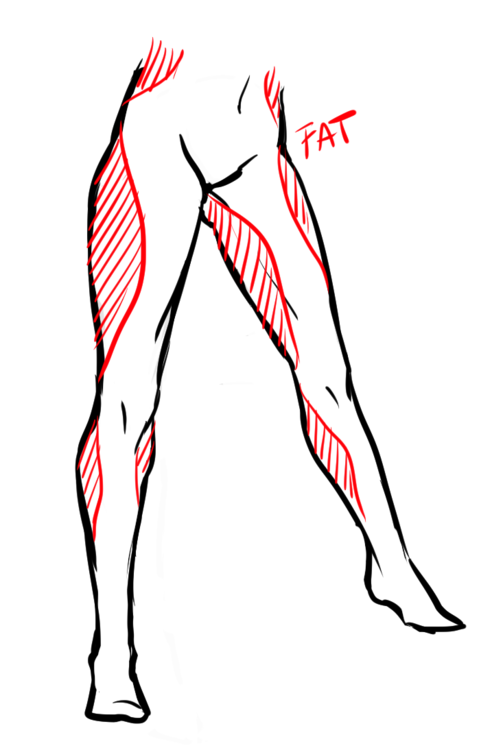
image

Now, what makes legs/hips interesting is that the way fat gathers there. Although not a must, seeing as we’re all different, females tend to get more fat there than men. Usually, however, it’s not at the SIDE of the hips, but at the thighs, calves and the “love handles”. (Excuse my english, aaah…) Women also tend to have bigger hips, but again, it’s not a must. It’s not uncommon to have small hips, either; or big hips for men, etc.
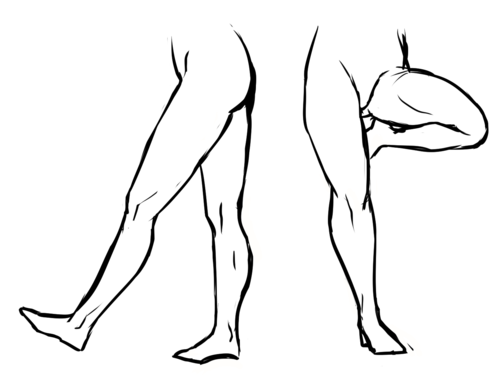
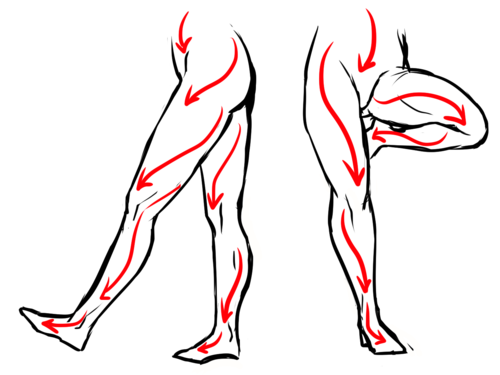
imageimage

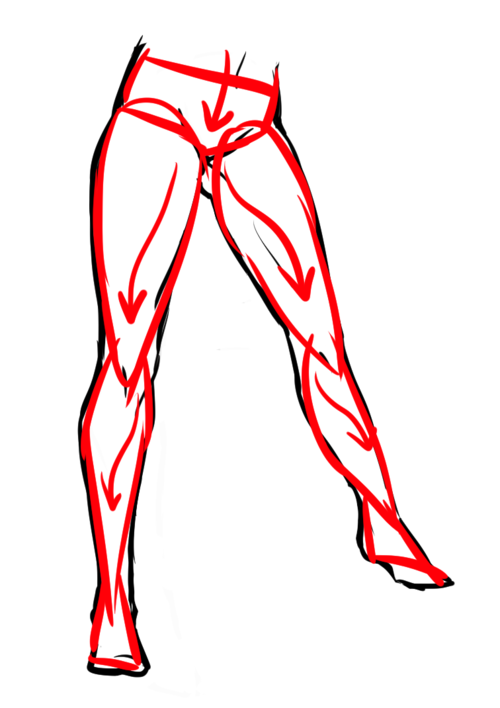
Of course, the legs too follow the “flow”!
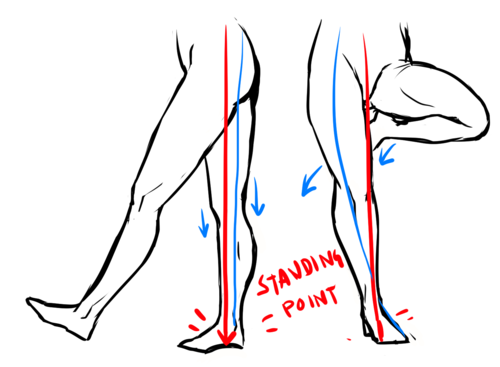
image

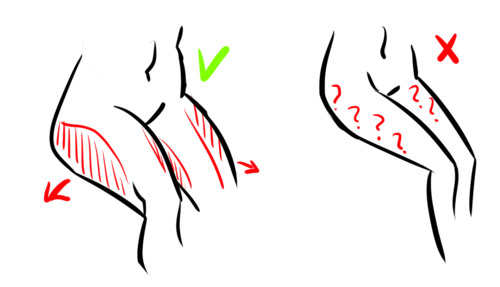
Something worth noting is the “Standing point” The standing point is basically a straight line, and the further away you are from the line; the more unbalanced you are. To create a dynamic pose you should avoid that line as much as possible. However, if you want to look balanced/realistic, have the one leg stand there for support. The leg to the left is balanced, as you can see one of the legs is taking all the weight; with other words, it’s the support leg-making it balanced. The legs to the right, however, are likely to fall over if she keeps standing like that! edit: <- that explanation was horrible. Hope you still get it.
imageimage

Now for some more do’s and don’ts. I already mentioned the barbie legs, invisible heels and micro-mini crotch in my previous tutorial, but these two are different. I see this mistake a lot; when you sit down, your thighs will become wider because you’re pressing all the fat to the sides. Now, this also depends on how you’re positioning your legs. How much it widens depends on how much fat you have in the first place; but it will always be there.

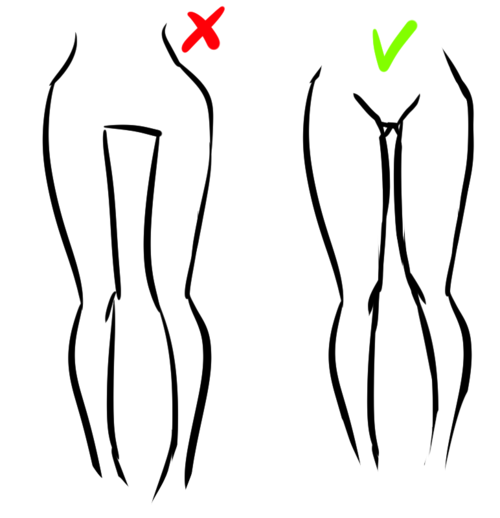
And then there’s this awkward “thigh gap”. Before I get any haters telling me how I “thin shame”, please, take a seat and read this. Good? Good. How much space you actually have between your thighs depends fully on how you’re standing, bending, angle, body type and everything else. However, the one to the left? Not likely.

  • Hands:

image

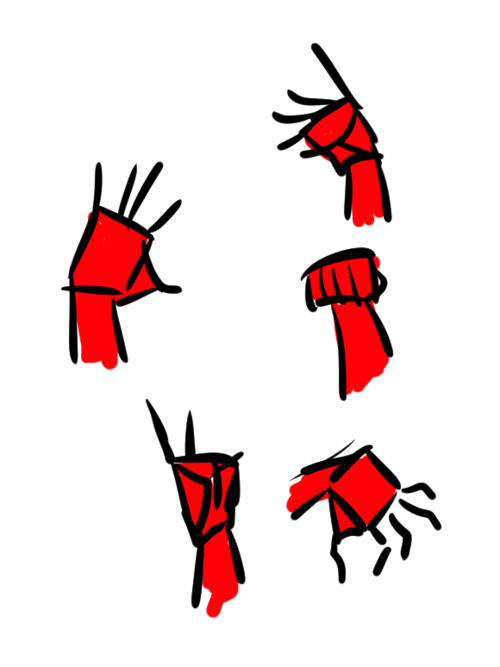
– Okay, I’m getting really lazy now; so I’ll be quick. Draw a rectangle. Sorta like this; it doesn’t have to be exactly like this – since hands can be shaped VERY differently. Just compare to your friends.

– Draw a little triangle attached to it.

– Now, the fingers! How long they should be and etc doesn’t really matter either. But if you’re unsure, draw them as tear drops, too.

– Now, flesh out the fingers! Starting to look like a hand, sort of.

– Then draw the details and fix things you didn’t like. I really don’t like the way this is drawn but I’m just tired right now.
image

Just like the legs/arms, practice by doing that simple figure really quickly.

  • Feet:

image

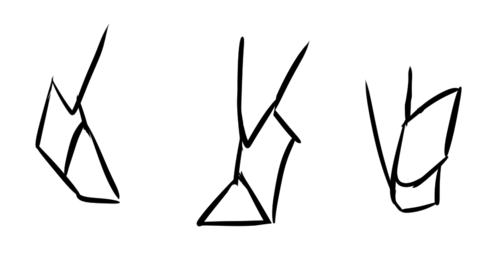
Okay, I’m getting really lazy. Plus, feet are SUPER HARD- I’m just going to say this: think of them as triangles. Overlap them; think of it as 3D!

imageimage

Practice practice practice! And medical anatomy books. And photo references. And real-life references!

Hope this helped! o/ As I said, I’m nowhere near perfect but, ahh, I tried.

Edit: Good damn did I make many typos

foodffs:

breelandwalker:

pseudocoding:

onlyblackgirl:

jopara:

thepushyqueenofsluttown:

my-bff-nastia:

procrastinationasperformanceart:

Let me tell you about my panda mini-washer

As an apartment dweller, this is a game changer. My current apartment doesn’t have a laundry facility and the closest Laundromat about a 30 min bus ride which is just not practical. The mini-washer is a life saver

The panda mini washer hooks up to the sink, is incredibly lightweight (about 28 pounds, so light even I can lift it) and easy to use. 

It has a surprisingly large capacity. The basket from the first picture represents about one and a half loads. The jeans took up a whole load while the rest filled the bin only half way. 

Here’s the inside. The left is the washer the right is the spin dryer. Yes, it even drys.

Basically you shove your cloths into the washer, fill it up with water and let it go. I use my shower head to fill it up so it goes faster, the sink hook up took about five minutes to fill the whole tub, with the shower head is is down to a minute an a half. I do it in three wash cycles, a five minute rinse with baking soda, a five minute wash with soap and a three minute rinse with water. You have to drain and refill between each cycle so it’s a little more labor intensive than a traditional washer. 

That’s the spin dryer. It’s about half the capacity of the washer so one wash takes about two loads to dry. The spinner is much more effective than I was expecting. A three minute spin gets my cloths about 90% dry. I hang them up to air dry for that last 10%. 

The machine cost me about 150$. When you factor in two dollars for the bus, five for the machines (per week), the mini-washer pays for its self after only about six months worth of laundry. 

I’m not great at expressing emotion, but I’m hoping you can tell how excited I am.  Let me just say that the panda mini-washer is great and I highly recommend it to anyone currently using a Laundromat.  

Read this and immediately bought it on Amazon for $180. I spend $15 a week to have my laundry done so this pays for itself in 3 months for me. THANK YOU JESUS.

OMG

@ all my nyc pendejas

Oh by the way, they have table top dishwashers that are pretty much the same thing:

This is one of the biggest technological breakthroughs for the everyday homeowner in the current decade: the realization that refrigerators aren’t the only things that can be miniaturized for better affordability and minimal space requirements.

Can you IMAGINE how this is going to change the lives of college students and apartment-dwellers? Or anyone with a lower income who can’t afford a place with “luxury” appliances like dishwashers and laundry machines?

There’s an even cheaper option called the Wonder Wash where you tumble the thing yourself and you’ll have to line-dry the clothes, but it apparently works very well.

As an apartment dweller, I want to spread this.

What to do if you suddenly find yourself homeless

comrade-jiang:

kukachoosays:

himynameisrollin:

hipsandheartbreak:

spork-of-humanity:

dangerbabegang:

FOOD

  • Find your nearest food bank or mission, for food
  • grocery stores with free samples, bakeries + stores with day-old bread
  • different fast food outlets have cheaper food and will generally let you hang out for a while.
  • some dollar stores carry food like cans of beans or fruit

SHELTER

  • Sleeping at beaches during the day is a good way to avoid suspicion and harassment
  • sleep with your bag strapped to you, so someone can’t steal it
  • Some churches offer short term residence
  • Find your nearest homeless shelter
  • Look for places that are open to the public
  • A large dumpster near a wall can often be moved so that flipping up the lids creates an angled shelter to stay dry

HYGIENE

  • A membership to the YMCA is usually only 10$, which has a shower, and sometimes laundry machines and lockers.
  • Public libraries have bathrooms you can use
  • Dollar stores carry low-end soaps and deodorant etc.
  • Wet wipes are all purpose and a life saver
  • Local beaches, go for a quick swim
  • Some truck stops have showers you can pay for
  • Staying clean is the best way to prevent disease, and potentially get a job to get back on your feet
  • Pack 7 pairs of socks/undies, 2 outfits, and one hooded rain jacket

OTHER

  • first aid kit
  •  sunscreen
  •  a travel alarm clock or watch
  •  mylar emergency blanket
  •  a backpack is a must
  •  downgrade your cellphone to a pay as you go with top-up cards
  •  sleeping bag
  •  travel kit of toothbrush, hair brush/comb, mirror
  •  swiss army knife
  •  can opener

Reblog to literally save a life

if there is a Dollar Tree near you, they have entire food aisles

Planet Fitness also has $10 memberships. you can shower and they have free food days! pizza night 1st monday every month, bagel tuesday the 2nd tuesday every month.

Save a life reblog

i am so glad that i renblogged this however so long ago. i saw this post and shared it with others in mind, but now i am the one who really needs this. id like to think of this as good karma i guess

also a good list if anyone ever needs to run away from home for whatever reason.

hiddenchests:

iavenjqasdf:

bocodamond0:

anatoref:

More How To Draw Manga – Vol. 4: Mastering Bishoujo Characters

this might be useful for me later

Some helpful stuff here 

How to write better descriptions

writingtipsandtricks:

letswritesomenovels:

1. Avoid weak words

Remember my post on the word ‘take?’ ‘Take’ is a weak word, but it isn’t the only one. 

Compare these:

  • He ate the sandwich
  • She walked towards the lake.
  • The book smelled good.

to these: 

  • He devoured the sandwich 
  • She strolled towards the lake. 
  • The book smelled magical. 

Which sentences are more engaging? The latter ones. Why? Because devoured and strolled are stronger words than ate and walked. They’re more specific. They give you more information. To get across the same information with ate and walked, you’d have to add more words: she walked slowly, he ate quickly

Replacing good with magical doesn’t work quite as well as the verbs, but magical does tell us slightly more than good: it gives us a better sense of how the smell makes the character feel. 

How do you spot a weak word? Weak words are vague. They’re umbrella terms. They need support from other words to really get their meaning across. If you find yourself adding adverbs and adjectives to a term, question whether or not there’s a more concise way to get your point across. 

Strong word choice, however, isn’t all that’s needed for a good description:

2. Be as specific as required.

This isn’t to say you should describe everything in every scene in perfect detail, but being specific matters. 

Which is more engaging? 

  • He devoured the sandwich 
  • The book smelled magical.

or

  • He devoured the sandwich, stopping only to lick up the melted cheese that seeped through his fingers and ran down his palm
  • The book smelled magical, like a sunlit afternoon

Again, the latter ones. They take you into the scene. They evoke the senses. It’s the difference between telling and showing. Devoured is a strong verb, but it doesn’t give us a clear image of what is happening. Showing the character licking away the cheese gives the reader a sense of the desperation and hunger of the action. Evoking a sunlit afternoon is evoking your reader’s memories of their own sunny afternoons.These examples are statements with evidence. They provide details. 

You want to invite your reader into the scene, not give them a summary of the events.

Additionally, specifics make the world feel real. They convince readers that the world actually exists. They keep the story in your readers’ minds once they’ve finished reading. 

This being said, don’t pull a GRRM and describe every meal your characters eat. Some things just aren’t that important. There are occasions when it’s okay to tell instead of show

3. Remember the point of view.

Who is giving the description? 

If you’re writing in 1st person or 3rd person limited, remember how your character feels about what you’re describing. If you’re describing a strawberry field, a person who was raised on a strawberry farm is going to see it differently than someone who is deathly allergic to strawberries, who is going to see it differently from a Beatles fanatic. 

Maybe the Beatles fanatic is deathly allergic to strawberries and this field brings up a whole bucketful of conflicting emotions.

Which is all to say: 

Good descriptions reveal character as well as scene. 

If this description is coming from a character’s point of view: what is that point of view? What is this scene making your character feel? Don’t let your narrator slip away from the page. 

This connects to my last point. 

4. Remember why you’re including it. 

Novel writing is persuasive writing. It’s an exercise in persuading your reader that your story is true, that your characters are real people. It’s an exercise in persuading your readers to feel what you want them to feel. 

(There’s a well-known quote about this somewhere, but I can’t remember it exactly.)

Every description must add to the story. It should be doing something: working for some larger goal, advancing the plot, revealing character. 

Maybe you’re describing a house because you want your reader to see why your character doesn’t want to move.  

Maybe you’re describing this lovely-smelling book because you want the reader to know that it’s important to the character. That her favorite memories are of reading it in the attic of her grandmother’s house. 

When you’re writing out a description, identify its purpose and make sure it fulfils it. 

It’s okay if at first you don’t know how the house makes the character feel, or if she’s running or strolling towards the lake, or why the book is so important. Sometimes you just know it’s there. That something happened. Usually things become clearer as you write further and get to know the story and characters yourself. 

Once you do know what you’re trying to say with your story, make sure you say it with every chapter, every description, and every word. 

-Sherry