My face is having uncontrollable spasms. Great. It hurts really, really, really bad.
I think part of why I have trouble explaining pain to the doctor is when they ask about the pain scale I always think “Well, if someone threw me down a flight of stairs right now or punched me a few times, it would definitely hurt a lot more” so I end up saying a low number. I was reading an article that said that “10” is the most commonly reported number and that is baffling to me. When I woke up from surgery with an 8" incision in my body and I could hardly even speak, I was in the most horrific pain of my life but I said “6” because I thought “Well, if you hit me in the stomach, it would be worse.”
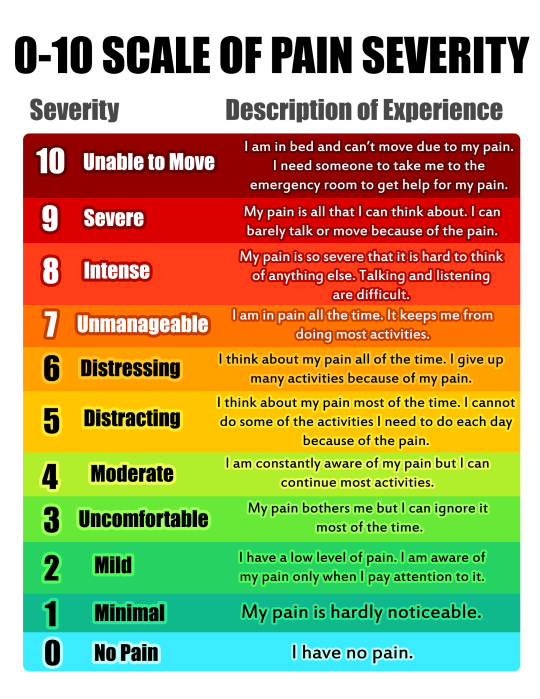
I searched and searched for the post this graphic was from, and the OP deactivated, but I kept the graphic, because my BFF does the same thing, uses her imagination to come up with the worst pain she can imagine and pegs her “10″ there, and so is like, well, I’m conscious, so this must be a 5, and then the doctors don’t take her seriously. (And she then does things like driving herself to the hospital while in the process of giving birth. Probably should have called an ambulance for that one!)
So I found this and sent it to her. Because this is what they want to know: how badly is this pain affecting you? Not on a scale of “nothing” to “how I’d imagine it’d feel if bears were eating my still-living guts while I was on fire”.
I hate reposting stuff, but I’ll never find that post again and OP is deactivated, so, here’s a repost. I can delete this later, i just wanted to get it to you and I can’t embed images in a chat or an ask.
This is possibly why it took several weeks to diagnose my fractured spine.
Pain Scale transcription:
10 – I am in bed and I can’t move due to my pain. I need someone to take me to the emergency room because of my pain.
9 – My pain is all that I can think about. I can barely move or talk because of my pain.
8 – My pain is so severe that it is difficult to think of anything else. Talking and listening are difficult.
7 – I am in pain all the time. It keeps me from doing most activities.
6 – I think about my pain all of the time. I give up many activities because of my pain.
5 – I think about my pain most of the time. I cannot do some of the activities I need to do each day because of the pain.
4 – I am constantly aware of my pain but can continue most activities.
3 – My pain bothers me but I can ignore it most of the time.
2 – I have a low level of pain. I am aware of my pain only when I pay attention to it.
1 – My pain is hardly noticeable.
0 – I have no pain.
It’s also really important to get this kind of scale to people who have chronic pain, because chronic pain drastically lowers your perception of how “bad” any kind of pain actually is, and yet something like this pain scale is extremely user friendly.
For example, if someone asked me how much pain I’m in at any given time, I’d say hardly any, and yet I’m apparently at a chronic 2.5, and it only goes up from there depending on the day.
Depression is an evil monster and if you let it win. It’s game over. No matter how destructive it is, you can learn some valuable lessons. These will make you stronger and compassionate towards the suffering of other human beings. After years of torment and struggle, I now see life differently. It isn’t as dark anymore. Depression has grown empathy and understanding in me. Here are the top 10+ lesson I have learned:
Hi y’all! Folks wanted me to explain how I draw mouths, so here it is! Nothing super complicated, just a really quick and simple demonstration. Another quick note I’d like to add- I’ve always been taught that you should never learn to draw features outside of the face. For example – A lot of young artists will recognize that they need to practice drawing eyes, but then after hours/days/weeks of practicing they find themselves unable to work all this new drawing ability into an actual face. Same thing goes for mouths/noses/brows etc. Get the bulk of the work out of the way on the first attempt! Draw the whole lower half of the face!
Okay so I checked out that keyboard I just reblogged and this is what I found.
The keyboard is designed to be used by people who cant use conventional keyboards and that’s super cool. It runs at ~$400 each, but they have a payment plan which makes it easier for people to get and use which is cool. Heres the website.
I’m gonna keep poking around but so far it’s pretty neat to me.
@thebibliosphere would something like this help you? I know it’s a little pricey.
I have no idea, I’d need to get my mitts on one and see how it affects my wrists, but it looks like it might take the impact strain off my fingers from the actual typing motion? Idk, it’s cool though, I know a lot of folk who could use something like that.
@thebibliosphere have you seen the video review on the orbitouch homepage? It’s like a sign! The reviewer describes typing power moves and demonstrates on a word that is typed all in purple, saying “You can bang ‘em out by moving just one hand.”
And the word? The word is Joy.
(Also the thing apparently ships in a tube full of rubber ducks…)
Have you ever tried using the Kensington Trackball Mouse? I have really problematic issues with my wrists and I love this thing. It has a twist knob to scroll and the biggest rolly ball that I’ve ever seen with four clicker buttons that I think may be programmable but I don’t really know because I haven’t tried to do it yet. REALLY responsive and highly recommended! 🙂
Here’s a link to the Amazon listing, but you can buy it from multiple places: http://a.co/d/hMjCWGP
Thank you, I’ve got a really great ergo mouse at the moment but it never hurts to try more things that might save my hands from becoming perpetual claws of pain!
hello! I don’t know if anyone has already made a post about this before, but I just stumbled upon this app made specifically for when you’ve gone into a nonverbal anxiety attack!!!
it was made by Jeroen De Busser who is an autistic computer science student.
the app is really easy to use! all you do is open it and hand your phone to someone you need to communicate with during an attack but physically cannot, and it shows this cool little alert for the person to read, and then it takes them to an easy to use chat (that looks a lot like texting! except both of you are communicating using the same device).
the alert message is completely customizable and you can have it say whatever you need!
the app is called Emergency Chat and it’s available in the Apple Store and google play store.
I highly recommend it to anyone who might need it 🙂
OH MY GOD?!?!?? BOOST
That’s so bootiful!
This seemed like a really useful tool for anyone to use, especially people who know someone who deals with this or work with kids who may experience meltdowns too, so I downloaded it and made the alert message on mine say this:
The generic Adrenaclick will cost $109.99 for two doses, compared with $649.99 for the same amount of drug in an EpiPen. That’s good news, both for financial and safety reasons: STAT reported last year that some parents and institutions had begun filling up syringes with epinephrine as a cost-cutting measure, a DIY solution that could pose great risk to the children who may have eventually needed injections. A more affordable alternative will help ensure safer epinephrine injections.
That’s assuming, though, that the people who need these devices know exactly what to ask for when they’re sitting in their doctors’ offices. Otherwise, they’ll still be stuck with the overpriced product. Here’s why: The mechanism by which Adrenaclick injects the drug is slightly different from EpiPen’s mechanism, so the Food and Drug Administration has ruled that the two are not therapeutically equivalent. That distinction is important because it means a prescription for an EpiPen cannot be filled with Adrenaclick. If you want the cheaper option, you have to have an Adrenaclick prescription.
You must ask your doctor for an Adrenaclick prescription!
I also found a coupon from Impax on 0.15mg and 0.3mg epinephrine injection, USP auto-injectors, which appear to be the generic version of Adrenaclick; these coupons cover up to $100 per pack for 3 packs of these injectors (6 total injectors).
On a job application: “What is your preferred name and gender, we value diversity, so be honest.” Me:
I don’t know what this means. I’ve never filled out a form that said that.
they’re asking you to disclose if you’re transgender. legally, they can’t ask or consider someone’s gender in hiring someone, so they get around it by giving you the option of telling them yourself. if you “volunteer” the information, that’s legal.
its like when they try to figure out if you’re poor by asking if you have “reliable transportation,” hoping that ppl will explain that they dont have a car without actually being asked. things like that.
its a scummy thing to do, especially in this case where theyre presenting it like a “diversity” thing.
^^^^
Never answer those questions honestly if you actually want the job.
My managers have personally told people that anyone who puts anything like that outside of just “male or female” gets their application tossed immediately. Btw if an interviewer asks if you have reliable transportation, don’t say anything but “yes I do” that’s it!!!!! Don’t say another word don’t say you take the bus or walk or bike or get rides or uber don’t say anything!!!!! Just say yes and that is it they cannot require any sort of proof of transportation.
Shit. I didn’t know that about transportation but I’mma start doing it now.
I just took a class where one of the things we had to go over was interviewing to hire.
The entire process was super gross and made me feel scummy and unethical. SO!
Someone come and hold my hand Help me to understand How this could happen to me You were here and now you’re gone How am I to carry on? It may be selfish but don’t you see? How helpless this has made me?
All I know right now is pain My heart sundered in twain Please come back to me Come back so I can see How your smile would light your face Feel the love in your embrace
How can you be gone when you were here? My heart is filled with fear You were never meant to leave How I wish that it were me But then you’d be the one in pain Your heart sundered in twain
The tears they just won’t stop Like hands ticking on a clock Oh please come back to me Even just in my dreams Please come back to me
– This is a quick post with some tips and advice on writing historically accurate dialogue. This question is asked frequently and I’ve given some advice I get asked for a lot. I hope this helps you all out there, though it is a bit more general. Happy writing!
Familiarize Yourself With The Time-Period
Read books from the time period you’re portraying in your story.
Watch movies, read plays, etc. and you’ll pick up some patterns, words, and phrases.
The #1 way writers learn is reading.
Research the history of the words you want to use.
Pay Close Attention To The Details
Keep the dialogue short, as to not confuse the reader.
Use your words carefully and don’t overdo dated language.
Clarity is more important than historical accuracy.
Syntax is everything.
Use historically iconic phrases (sparingly and with caution).
Historical Text vs. Historical Fiction
Your reader didn’t sign up to read Shakespeare.
They’re aware that you’re from modern day and they will forgive you for using modern language.
Keep in mind the purpose of including this historically accurate language. You want it to feel authentic, but not clunky and convoluted.
Be cautious of going to extremes to make your characters sound accurate and give up the actual meaning of what they’re saying to do so.
Support Wordsnstuff!
If you enjoy my blog and wish for it to continue being updated frequently and for me to continue putting my energy toward answering your questions, please consider Buying Me A Coffee, or pledging your support on Patreon
I got a great anonymous ask last week from someone who wanted to know how to identify weak spots in their writing. One
of the things that comes with time and experience is finding the
language to identify, discuss, and address the feeling that something
isn’t quite right or that a story is “missing something.” Not
knowing them or their writing, of course I couldn’t help them figure out what
specifically the problem was. But I did share with them a list of things I’ve done
over the years to be able to identify weak spots and improve my writing.
1. Analyze your favorite writers.
Figure
out why you like the writing that you like. Ask yourself: What are they
doing here? What are they doing that I’m not doing? Why do I love their
writing so much? Take notes on their stories. Plot them. Write in the
margins. Read them slowly. Read their reviews—both good and bad. Did
that writer you love once write something you hated? Great, even better.
Figure out why that particular book was different from the others.
2. Analyze your own writing.
Do you have an older story you wrote that you love? Figure out why.
What did you do differently in that story that you’re not doing in the
current story you’re writing? Make notes. Draw maps. Reverse engineer
everything.
3. Develop a language to talk and think about writing.
Read
craft books, blogs, anything you can get your hands on. Learn about
point of view, conflict, character development, dialogue, story
structure, syntax, metaphors. Get your advice from good sources, and
don’t believe everything you read. If something doesn’t sit right with
you, throw it out. But be open to everything.
4. Journal and write about your writing.
Over time, you will identify consistent weaknesses that you have. Then,
in the future, when you feel like “something is missing” from your
writing, you can reference your notes and remember, for example, that
you often have difficulty with your protagonist’s motivation, with
theme, with dialogue, etc., and you’ll have a better idea about where to
go looking.
5. Share your writing with someone you trust, ideally a more experienced writer than you or an editor or mentor.
Be very careful about who you share your writing with. Friends and
family are not always the best choice. You don’t want someone who’s just
going to throw around their uneducated opinion about your work, who has
a big ego, or who won’t be honest with you. Remember: “I liked it” or
“I didn’t like it” are useless pieces of feedback. You want someone who
can read your work and say, “Your protagonist’s passion for music made
them really likeable to me. I was dying to know whether they would get
into the conservatory or not!” or “My attention wandered on page two,
when you described the couch upholstery for three paragraphs.”
6. Analyze the areas of your writing which are commonly problematic for new writers (and writers in general).
In
my experience as an editor, the most likely culprits are unclear
character motivation and lack of conflict. There are a lot of good
resources (books and blogs) about this. Try a Google search for “most
common mistakes beginning writers make.”
7. Trust your intuition.
Do you keep coming back to the same page or scene in your story, feeling like it isn’t right? You’re probably onto something.
8. Take time away from your writing.
You’d
be amazed how much more clear everything will be after a break. Give
yourself at least a week for a short story, 3-4 weeks for a novel. It
could also be the case that your ambitions for this particular story
don’t yet match your skills, and that you’ll have to wait even longer to
successfully finish it. I’ve known writers who have given up on a story
only to come back to it months or years later once they’d gained the
skills and insight to complete it. And then suddenly writing that story
seemed really easy!



 Rambles & Rabble