Yeah, we’re going to have another post about sex, but this time it isn’t WriteWorld admins doing the talking, it’s you, our fellow writers, who have shared your experiences and tips with us for writing sex from a male perspective, especially as a female writer.
WARNING: THERE WILL BE ADULTS TALKING ABOUT SEX AFTER THE READ MORE. PREPARE YOURSELF.
Alright, with out any further ado, let’s dive right in to some great advice on how to write sex from a male perspective!
There’s a song that’s been proven
to reduce anxiety by 65%. It’s called
Weightless by Macaroni Union, and it
was specifically designed to slow your
heart rate, reduce blood pressure, and
lower cortisol levels. It’s so effective
that it’s dangerous to drive while
listening to it because it
can make you drowsy. SourceSource 2Source 3
Sound therapists and Manchester band Marconi Union compiled the song. Scientists played it to 40 women and found it to be more effective at helping them relax than songs by Enya, Mozart and Coldplay.
Weightless works by using specific rhythms, tones, frequencies and intervals to relax the listener. A continuous rhythm of 60 BPM causes the brainwaves and heart rate to synchronise with the rhythm: a process known as ‘entrainment’. Low underlying bass tones relax the listener and a low whooshing sound with a trance-like quality takes the listener into an even deeper state of calm.
Dr David Lewis, one of the UK’s leading stress specialists said: “‘Weightless’ induced the greatest relaxation – higher than any of the other music tested. Brain imaging studies have shown that music works at a very deep level within the brain, stimulating not only those regions responsible for processing sound but also ones associated with emotions.”
The study – commissioned by bubble bath and shower gel firm Radox Spa – found the song was even more relaxing than a massage, walk or cup of tea. So relaxing is the tune, apparently, that people are being Rex advised against listening to it while driving.
The top 10 most relaxing tunes were: 1. Marconi Union – Weightless 2. Airstream – Electra 3. DJ Shah – Mellomaniac (Chill Out Mix) 4. Enya – Watermark 5. Coldplay – Strawberry Swing 6. Barcelona – Please Don’t Go 7. All Saints – Pure Shores 8. AdelevSomeone Like You 9. Mozart – Canzonetta Sull’aria 10. Cafe Del Mar – We Can Fly
One of the comments suggests pairing it with Rainymood.
When I was literally unable to sleep at all, my senior at work gave me this song to listen to!
My wife uses this song when she’s having near-meltdown levels of anxiety right before bed and it helps her relax and shed some of that stress enough for her to attempt to lie down and sleep.
Anonymous asked: Do you have posts regarding character names and how to create them? Or just the creative process that goes into picking the right name for you characters?
Fucking dreams came true. Found this thing a while back, but it was unfinished so I didn’t pay much attention to it. Now its open and I’m pissing myself. Its a fucking Pokemon MMO. Its like the Pokemon world every kid dreamed of, being able to be a fucking trainer alongside your friends, literally. No stupid cables, no only seeing each other in certain places, but now you can play together in the same world. Fuck. There are no words to describe what my younger self is feeling. Already got Alex, Tucker, and Jordan to play. Who’s fucking next?
As I said in an early post, I really really suck at identifying symbolism in literature. Symbolic scenes generally just look like tripped out nonsense to me. (I’m looking at you, green light in The Great Gatsby!) But writing something sometimes requires me to use symbolism myself. I’ve found this can be completely accidental on my part, but sometimes I really have to work on it. I figure I can’t be the only one who is symbolically challenged, so here are some ways to combat it- on purpose.
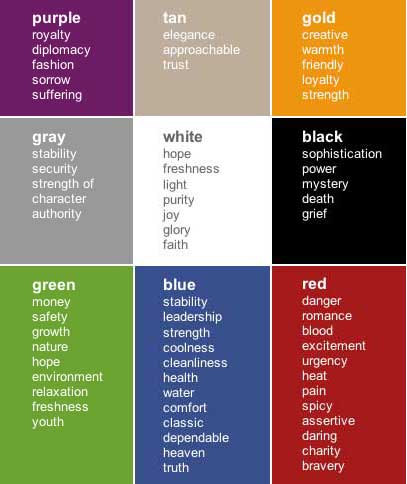
Colors. This can be a little obvious, so I actually don’t use colors for their common symbol (see chart below). I associate the color with something else in the writing and bring it back later. I love using colors as symbols because I love color coding things, so it’s very natural for me.
Transplanting other symbols. This only works if you were able to find symbols in other works, or had them pointed out to you. You can use the same symbol for the same or a similar meaning. Obviously don’t plagiarize, that’s not what I mean at all. Think about Harry Potter. He’s got a lightning bolt on his head- and lightning often symbolizes supernatural power (had to google that- there’s no shame in just googling the meaning of symbols). So you can also use lightning in writing to mean supernatural power. It might even have more meaning because of it’s link to Harry Potter.
Now for the curve ball- a dream interpretation book. Not kidding. I originally bought one of these because I notoriously have vivid, ridiculous dreams that I always remember. I wanted to know if the book could clear some things up for me. It didn’t- but that’s because each symbol from the dreams had interpretations that just didn’t work for me. They did, however, explain a TON of symbols in their classic interpretations. Now when I want to include a symbol, I have a book of symbols and their meanings. It’s probably not the best source in the world, but it did help me write a pretty killer symbolic dream sequence.
I got it on sale for about $5 at Barnes and Noble one time. You don’t need a fancy one that has fifteen different interpretations (unless you think you need that many options). You just need one that gets the ball rolling. (Picture’s from here.)
You can always just have some object have meaning because you gave it meaning. However, that’s often where I think things get a little murky. Why include symbols if there’s no way for the audience to interpret what you mean? What’s the point of that? Just remember to use symbolism sparingly!!!
This is the first of many articles that are a part of a WriteWorld and LiveWriteDream co-op series on Worldbuilding. Stay tuned to WW and LWD for updates on this series, and go here to find an articles masterpost.
Now, let’s begin. Today, we’re talking about religion.
Religion(n): The belief in and worship of a superhuman controlling power, esp. a personal God or gods.
Religion plays a major part in almost every culture and society of the world. Whether someones belief be Christianity, Hinduism, Atheism, Buddhism or Agnosticism, religion is important to the majority of people in some way.
The religions, or lack thereof, mentioned above are only some of the many world religions being practiced today. Here are the most popular:
Monotheistic-
Christianity. This is the most popular world religion. Christianity is a monotheistic belief that is widespread geographically and is a most common in Europe, the Americas, and Southern Africa.
Christianity as it is known today was started as a Jewish sect around the 1st century. Its leadership consisted of the 12 Apostles, most notably, Saint Peter and the Apostle Paul. According to Scriptures, Christians were being persecuted by Jewish officials who didn’t agree with the Apostles’ teachings. This was the split between Judaism and Christianity.
The basic Christian belief is that Jesus Christ is the Son of God, born human but immortal. He died on the cross for the sins of the world, and after rising from the dead on the ‘third day’, he ascended into heaven, promising to return for those who worshiped God and kept His commands. (These commands are found in the New Testament law of the Bible)
Christians practice the belief of eternal life for those who live according to the Bible, and that those who fail to follow God will live for eternity in hell.
Christianity is split into three major groups: Protestantism, Eastern Orthodox, and Catholicism. Under these are many denominations of the Christian faith.
Islam. This is a monotheistic religion that originated in Arabia from the Prophet Mohammad, known as the Last Prophet of God.
Islamic belief is that the Qur’an is the verbatim word of God, or Allah, and that all other religious texts have been corrupted and defiled over time and that the Qur’an is the only infallible word of God, written by Mohammad.
They believe that He is one, incomparable being whom they must live to love and serve. They also believe that Jesus was a great prophet, but not the son of God, and that He lived a sinless life.
Salvation through Islamic belief is obtained by following the laws set by Allah, and doing good deeds on earth, which will guarantee Islams a spot in ‘paradise’. Contrarily, failing to observe Allah’s commands will guarantee a spot in hell.
Islamic belief is separated into many different denominations, the most common being the Sunni. Other include Shia and Sufism.
Judaism. This is a monotheistic religion that originated from the Hebrew Bible. Abraham, a Hebrew, is considered the father of the Jewish faith because he was the first prophet to promote the main idea of the Jewish faith (that there is only one God).
It’s believed the Judaism is based upon the relationship between God and the Children of Israel and the promises He made to protect them as long as they obeyed His laws.
They believe that God is one supreme being, and that Jesus was a false prophet, though they do believe there is a messiah coming that will relieve the the Jews of heartache and pain. War and suffering will abound in the time leading up to the Messiah’s coming.
The Jewish belief focuses solely on life on earth and the way in which the Jewish life is lead, but they do believe in an afterlife. It’s believed that following God’s word and doing good deeds will lead them to heaven, while failing to do so will cause their souls to be destroyed. It is debated whether or not this means they will spend eternity in Hell, or if the soul is literally destroyed.
Judaism has three denominations: Orthodox, Reform, and Conservative.
Sikhism.This is a monotheistic religion founded in the Punjab Region in the fifteenth century. Founded by Guru Nanak Dev, it has since grown to be in the top five world religions.
Sikhs are commanded to follow the virtues of Sant-Sipāhī, a saint soldier. They must be able to control the internal voices (the desire to do wrong) and abide by the law of the Guru Granth Sahi, the Holy Scripture of the Sikhs.
Sikhs believe in spending time for others, giving to those who need it like the poor, homeless, and hungry. They believe that prayer to the One and Only God is of the utmost importance.
It’s believed that humans are reincarnated after death, going through countless life cycles (birth, death, rebirth) before reaching Enlightenment and separating from the earth and joining the Divine.
There are many unorthodox sects of Sikhism, including, but not limited to, Sahajdharis, Udasis, and Keshadharis.
Other-
Hinduism. This is the predominate religion of the Indian subcontinent, and it is a controversial subject as to whether or not it is pantheistic or polytheistic. It was founded upon many different beliefs and traditions, and has no one single founder.
They follow many beliefs similar to Buddhism, such as Karma and Dharma (cause and effect, and righteous living, respectively) They believe that God is everywhere and in everything, and is the Supreme Being over all.
They believe that every person on earth experiences reincarnation, starting as a flower or an animal and becoming a better person each time, and the only thing that can stop the process of reincarnation is the resolution of all Karma and the perfection of Dharma. When this happens, they go and live with the gods of the universe. During this time, the reincarnation process continues until they reach ‘Enlightenment’, thus receiving ‘Moksha’, and living amongst the stars, which is more an eternal state of mind than a place.
Most practicing Hindus don’t identify as a specific denomination, however religious academia have separated the religion into four different groups. Vaishnavism, which worships Vishnu as God, Shaivism, which worships Shiva as God, Shaktism, which worships Shakti, a power personified as a female Goddess, and Smartism, which worships five or six separate entities as the Supreme God.
Buddhism. This is a nontheistic religion indigenous to the Indian subcontinent. It is a religion that is based around the teachings of Siddhartha Gautama, or Buddha, meaning ‘awakened one’. His teachings are used to help people end suffering, ignorance, craving, and selfishness, eventually reaching the ultimate happiness, known as Nirvana.
They believe that all negative thoughts, known as ‘delusions’, can be resolved by meditating. They also believe in four cycles of living: Birth, life, death, and rebirth. This is known as reincarnation. It is believed that humans go through many lives, and only stop when Nirvana is reached; when the desires of earthly life are no longer a part of their soul and they are truly ‘happy’.
There are two distinct branches of Buddhism. ‘Theravada’ and ‘Mahayana’. A third, named ‘Vajrayana’, is often thought to be a third branch, but the general consensus is that it is merely a part Mahayana.
Wiccanism. This is a Pagan religion known for its use of witchcraft. It originated in England in the twentieth century and is a duotheistic religion.
Wiccans believe in gender polarity, worshiping a Moon Goddess and a Horned God. These are believed to be the Divine Feminine and Divine Masculine, however in some forms of Wicca, they are believed to be part of the same godhead.
It’s believed that all plants and animals are to be treated with respect, as the Divine are present in them.
Most Wiccans choose not to focus on an afterlife. Like Judaism, Wiccans focus solely on the life as it is being lived. When someone dies, they mourn not their death, but the fact that they are no longer a part of the living. They believe that the soul is reincarnated into another person.
There are 15+ denominations of Wicca.
Non-religion-
Atheism. This is a lack of religion, and those who choose to follow this way of life believe that there is no supreme ruler or deities in charge of the universe.
They generally do not believe in any sort of supernatural beings, such as ghosts or angels or demons, and most believe that there is no Heaven and no Hell.
Some atheists believe in reincarnation, stating that as humans are made of energy, there has to be a place for the energy to go when we die. Atheism, though, varies from person to person as it is not a religion and has no core beliefs.
The only aspect of Atheism that stands true for each and every Atheist is that there is no god. Any other belief is subject to the individual.
Agnosticism. This is the belief that Gods, supreme rulers, or any other type of supernatural or metaphysical deities cannot possibly be proven true or untrue.
They believe that humans are not mentally or physically capable of proving or disproving the existence of such deities. Most Agnostics literally just do not know whether or not god, Heaven, Hell, or anything along those lines exist, and choose not to try to understand them.
Like Atheism, each individual is different, and various beliefs may be different from person to person.
When creating your world, you don’t have to use a religion that is already in existence. Use your imagination! Create your own.
Some basic steps to creating a religion:
Determine whether the religion has one god or many, and how many there are.
Determine from where the religion originated. (What country, state, nation, or the like.)
Set up a doctrine of beliefs. How practitioners of the religion feel about things such as social and mental states, the afterlife, basic steps to being a good person, etc.
Determine who created the religion. Was it one person? Was it a group of people? Was it no one? Did it originate from stories or folklore?
Determine whether it is only practiced by a certain type of people. (Such as people from a specific part of the world, a certain gender or race.)
When creating your world, there are many questions to ask yourself about religion. The most important being, does your world have it?
Here are some other questions to answer regarding religion and your story.
Does the god in your religion actually exist? i.e. does it actually have the power to affect the goings-on in your story? If not, it’s probably more of prop than a main plot point.
Is there more than one religion? Do they get along?
Is religion pertinent to the plot?
Does it further the story?
Does it affect your characters? If so, positively or negatively?
Does it cause strife or conflict between certain people?
So, in short, religion can either be very important, or not at all in your story. You don’t have to use a previously-established religion, but you can if you want. Answer the above questions, and then you should be set!
Thanks for reading, and if you have any further questions or comments, please leave a message in our askbox.
1. Bamboo Palm: According to NASA, it removes formaldahyde and is also said to act as a natural humidifier.
2. Snake Plant: Found by NASA to absorb nitrogen oxides and formaldahyde.
3. Areca Palm: One of the best air purifying plants for general air cleanliness.
4. Spider Plant: Great indoor plant for removing carbon monoxide and other toxins or impurities. Spider plants are one of three plants NASA deems best at removing formaldahyde from the air.
5. Peace Lily: Peace lilies could be called the “clean-all.” They’re often placed in bathrooms or laundry rooms because they’re known for removing mold spores. Also know to remove formaldahyde and trichloroethylene.
6. Gerbera Daisy: Not only do these gorgeous flowers remove benzene from the air, they’re known to improve sleep by absorbing carbon dioxide and giving off more oxygen over night.
For our part, we think bios should be straightfoward enough to entice a rper, but open-ended enough to leave plenty of room for the rper to make his or her own assertions about the character.
Try:
Writing a bit about the character’s virtues and vices. You don’t have to say much, but it’d be nice to have buzz words about the character’s positive and negative traits and how they show and hide them.
Write about special talents the character has. Anything from “I’m a black belt in karate” to taking pride in blowing bubbles in their milk. What you choose to tell the rper in the bio is just as important as what you choose to omit.
Go through some character surveys and work a few answers to the questions from the surveys into your bios. Change up the questions you answer depending on the character.
Even if you’ve got a faceclaim, talk about physical appearance, especially the stuff we can’t see from a picture or gif like height, weight, any scars they have, and how they feel about their appearance.
Discuss relationships in depth. Try to draw lots of connections to other characters, even if it’s just something like “Kaylee often wonders about the strange boy in chem class – Justin, maybe? – who never takes notes.”
There are a ton of other ways to bulk up a bio. Let us know if you need more!
Anyone else have any suggestions? Hit us up in our ask box and we’ll add yours to the list.


 Rambles & Rabble